News Summary
- Max Verstappen has scored 68 points in the last three Grands Prix, compared with Kimi Antonelli’s 43, including victories in Malaysia and Singapore.
- Red Bull has been Formula 1’s fastest team on estimated race pace since Azerbaijan, according to the championship’s official performance analysis.
- Antonelli remains 119 points ahead of Verstappen in the Drivers’ Championship, with Mercedes preparing further developments for Austin.
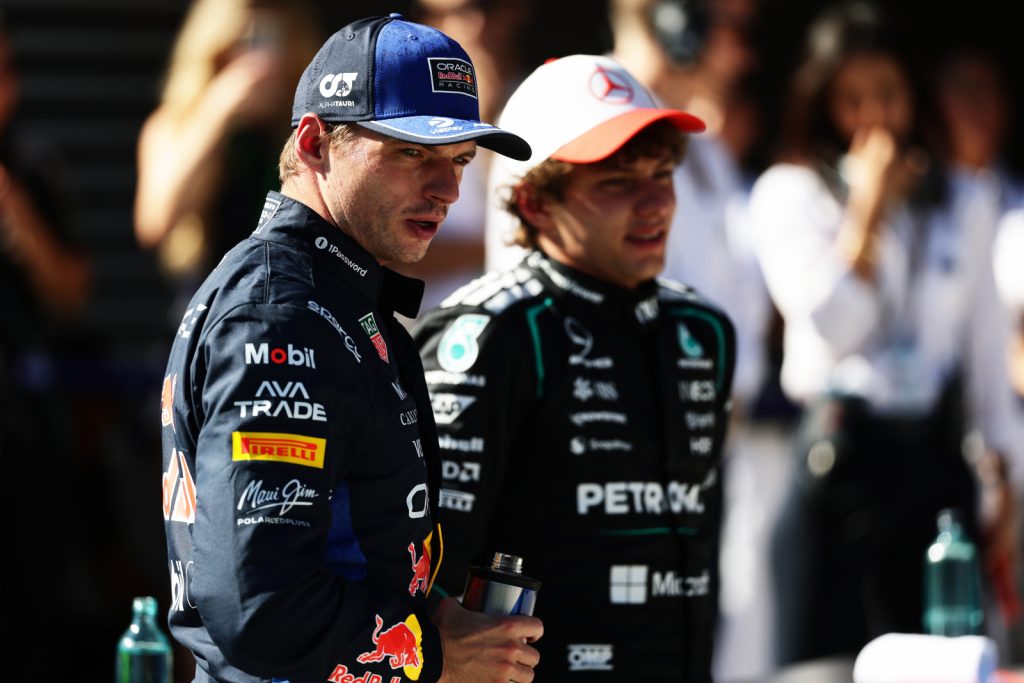
Max Verstappen has emerged as Formula 1’s strongest performer over the last three Grands Prix, outscoring Kimi Antonelli by 25 points and winning consecutive races in Malaysia and Singapore, but the comparison between the Red Bull driver and the Mercedes championship leader reveals a more complex picture than the race results alone suggest.
Since Azerbaijan, Verstappen has scored 68 Grand Prix points compared with Antonelli’s 43, finishing ahead of the Italian in all three races. The Dutchman narrowly missed victory in Baku before winning at Sepang and Marina Bay, establishing Red Bull as Mercedes’ most serious recent challenger.
The turnaround has been particularly significant because Antonelli dominated much of the first half of 2026, building a championship lead that now stands at 102 points over teammate George Russell. Verstappen remains 119 points behind the Italian, making the recent performance comparison more relevant to the battle for race victories than to the overall title outcome.
Verstappen vs Antonelli: Results since Azerbaijan
The last three Grands Prix provide a clear comparison of their recent results.
| Grand Prix | M. VERSTAPPEN | K. ANTONELLI | Points VER–ANT |
|---|---|---|---|
| Azerbaijan | 2nd | 5th | 18–10 |
| Malaysia | 1st | 2nd | 25–18 |
| Singapore | 1st | 3rd | 25–15 |
| Total | 2 wins, 3 podiums | 2 podiums | 68–43 |
Grand Prix results only. Sprint points are excluded to maintain a consistent comparison across the three races.
Verstappen’s advantage amounts to 25 points, with an average finishing position of 1.33 compared with Antonelli’s 3.33.
The figures demonstrate the Dutchman’s stronger results during the period, although they do not establish a precise lap-time advantage because race outcomes also depend on strategy, traffic, tyre management and interruptions.
Azerbaijan marked the beginning of Red Bull’s recovery
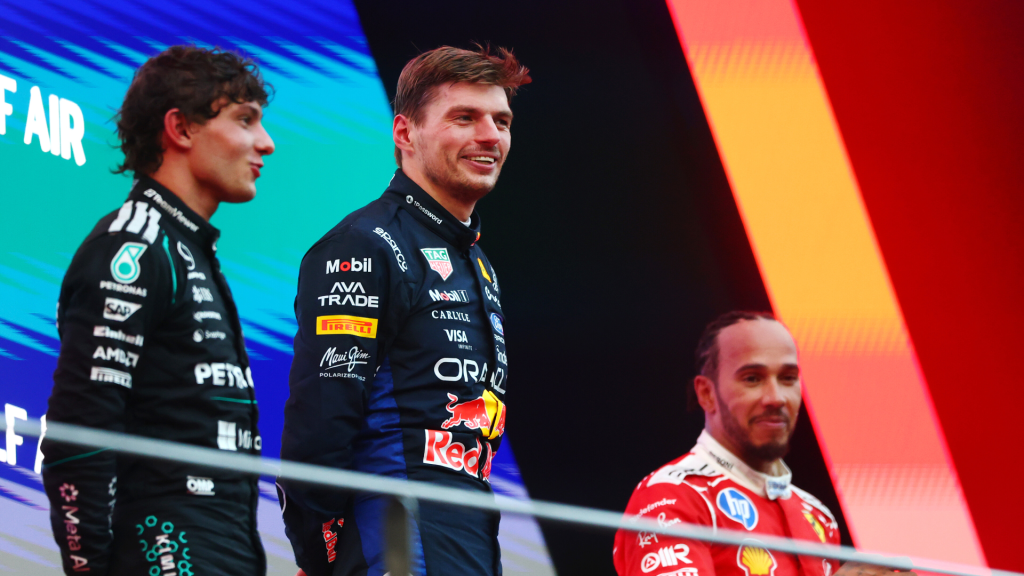
The turnaround became apparent at the Azerbaijan Grand Prix, where Verstappen finished just 0.196 seconds behind George Russell after a dramatic late battle.
Antonelli recovered from 16th on the grid to finish fifth, scoring ten points despite a difficult qualifying session.
The race therefore produced different challenges for the two drivers.
Verstappen fought for victory at the front, while Antonelli spent much of the afternoon recovering positions.
Comparing their average race lap times without correcting for traffic and race circumstances would risk exaggerating the difference in underlying performance.
However, the result demonstrated that Red Bull had become capable of challenging Mercedes for victories again.
The recovery of Red Bull’s competitiveness after its difficult early-season form provided the foundation for the Dutchman’s subsequent victories.
Malaysia delivered Verstappen’s first victory of 2026
Verstappen converted pole position into victory at Sepang, securing Red Bull Ford Powertrains’ first Formula 1 win.
Antonelli finished second, 2.307 seconds behind, after a race affected by changing weather conditions and a late safety car.
The result was significant because Malaysia presented a different technical challenge from Azerbaijan.
Sepang’s high-speed corners, heavy braking zones and demanding tyre conditions required a different aerodynamic and mechanical balance.
Red Bull’s competitiveness at both circuits suggested that its improvements were not limited to a single track configuration.
Verstappen’s pole position was also particularly revealing.
The official Formula 1 performance analysis identified Malaysia as the weekend when Red Bull established its largest qualifying advantage over Mercedes during the season.
Antonelli qualified fourth, while Russell was eighth, demonstrating that the German team had struggled to reproduce its earlier qualifying dominance.
Singapore confirmed Red Bull’s advantage
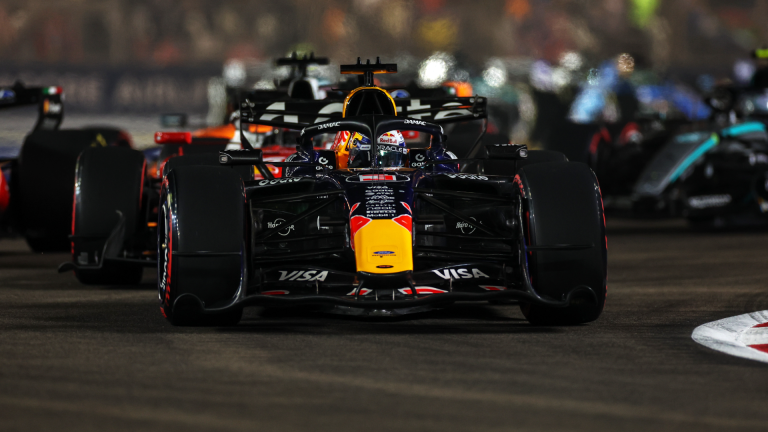
Verstappen followed his Malaysian victory by winning the Singapore Grand Prix, completing 62 laps in 1:42:00.785.
Charles Leclerc finished second, 7.335 seconds behind, while Antonelli secured third place at a deficit of 24.573 seconds.
| Position | Driver | Team | Race time / gap |
|---|---|---|---|
| 1 | M. VERSTAPPEN | Red Bull | 1:42:00.785 |
| 2 | C. LECLERC | Ferrari | +7.335 |
| 3 | K. ANTONELLI | Mercedes | +24.573 |
| 4 | L. NORRIS | McLaren | +40.506 |
| 5 | O. PIASTRI | McLaren | +49.644 |
The 24.573-second gap between Verstappen and Antonelli provides a useful measure of the difference in their final race results, but it should not be interpreted as a pure pace deficit.
Strategy, tyre degradation and race management all influence the final classification.
Nevertheless, Verstappen’s victory at a demanding street circuit reinforced the impression that Red Bull had solved several of the weaknesses that limited its competitiveness earlier in 2026.
What does the official F1 race-pace analysis reveal?
Formula 1’s official technical analysis, published on October 16, identified Red Bull as the fastest team on estimated race pace since the Azerbaijan Grand Prix.
The assessment considered performance in clean air rather than relying exclusively on finishing positions.
That distinction is important because a driver can possess superior underlying pace without winning, particularly when overtaking is difficult or strategy limits opportunities.
Mercedes remained the strongest team across the season as a whole, having claimed 11 of the first 17 pole positions.
Antonelli secured six of those poles, compared with five for Russell.
However, the balance shifted during the closing stages of the season.
Red Bull improved significantly from a deficit exceeding 1% to Mercedes in Japan, eventually establishing an advantage during the later rounds.
In Malaysia, Verstappen delivered the team’s strongest qualifying performance relative to Mercedes.
The official analysis therefore supports the conclusion that Red Bull has become the recent race-pace benchmark, although it does not provide a single verified average lap-time difference between Verstappen and Antonelli across all three events.
Does Verstappen’s recent form threaten Antonelli’s championship?
Antonelli enters Austin with 340 championship points, compared with Verstappen’s 221.
The 119-point gap means the Dutchman would require an extraordinary combination of results to recover his deficit during the final six rounds.
With 150 Grand Prix points still available before Austin, Verstappen remains mathematically within range, although Antonelli’s advantage and victory count make the Italian’s position exceptionally strong.
The more immediate question is whether Verstappen can prevent Antonelli from winning the United States Grand Prix.
Verstappen’s recent performances therefore represent a direct obstacle to the Italian’s earliest possible title celebration.
Red Bull’s recovery has also transformed the Constructors’ Championship battle.
McLaren’s former 83-point advantage over Red Bull has fallen to seven points, increasing the importance of Verstappen’s results during the final rounds.
Austin will test whether Red Bull’s advantage is sustainable
Circuit of The Americas combines high-speed direction changes, long straights and slower corners, making it a demanding test of aerodynamic efficiency and mechanical balance.
Verstappen has won four Grands Prix at Austin and can equal Hamilton’s five-victory record if he wins again.
His pursuit of Hamilton’s Austin record adds another dimension to the weekend.
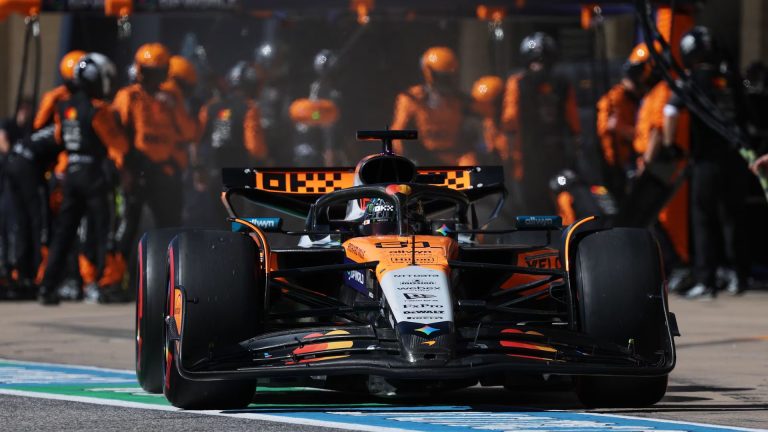
Mercedes will introduce its latest development package, while McLaren and Ferrari are also preparing changes.
The McLaren floor and brake upgrades for Austin demonstrate how the competitive order could change again during the final races.
For Antonelli, the objective is to recover the performance advantage that allowed Mercedes to dominate much of 2026.
For Verstappen, Austin offers an opportunity to establish whether Red Bull’s recent superiority can continue across another circuit with different demands.