News Summary
- Ferrari has 444 points and sits second after Singapore in 2026, compared with 298 points and third place at the same stage in 2025.
- The team trails Mercedes by 134 points, a substantial improvement over its 352-point deficit to McLaren in 2025, but worse than its 75-point gap in 2024.
- Recurring strategic disputes involving Lewis Hamilton and Charles Leclerc have increased pressure on Vasseur, while speculation about Christian Horner adds another complication.
Frédéric Vasseur is experiencing one of the most contradictory periods of his Ferrari career. The Italian team is performing significantly better than it did in 2025, yet questions about its leadership, strategic decisions and internal confidence have become increasingly difficult to ignore.
After the Singapore Grand Prix, Ferrari occupies second place in the 2026 Formula 1 Constructors’ Championship with 444 points, trailing Mercedes by 134. Charles Leclerc and Lewis Hamilton have shown enough speed to challenge at the front, and the team has already achieved a substantial improvement over its disappointing previous campaign.
But Singapore also exposed another weakness.
Hamilton missed a pit-stop opportunity during a Virtual Safety Car, losing what Vasseur believed could have been a double podium for Ferrari. Leclerc finished second, while Hamilton dropped to sixth and subsequently apologised to the team.
The incident followed disagreements over strategy and driver cooperation at Zandvoort, Monza and Sepang, reinforcing questions about whether Ferrari has established the operational consistency required to challenge for a world championship.
Meanwhile, former Red Bull team principal Christian Horner continues to feature in speculation about Vasseur’s future, despite Ferrari publicly supporting its current leadership.
The central question is whether Ferrari’s 2026 problems represent another failed season under Vasseur — or whether the championship standings reveal a more complicated picture.
Ferrari under Vasseur: how the team compares after Singapore
Vasseur became Ferrari team principal at the beginning of 2023, replacing Mattia Binotto.
His first four seasons provide an opportunity to compare Ferrari’s development across different technical and competitive circumstances.
Using the championship standings immediately after the Singapore Grand Prix in each season, the results reveal significant fluctuations.
| Season | Rounds completed | Ferrari position | Ferrari points | Championship leader | Leader points | Ferrari deficit |
|---|---|---|---|---|---|---|
| 2023 | 15 | 3rd | 265 | Red Bull | 597 | -332 |
| 2024 | 18 | 3rd | 441 | McLaren | 516 | -75 |
| 2025 | 18 | 3rd | 298 | McLaren | 650 | -352 |
| 2026 | 17 | 2nd | 444 | Mercedes | 578 | -134 |
Figures represent the Constructors’ Championship standings immediately after Singapore in each season, rather than the final championship results.
Ferrari’s position in 2026 is its strongest at the Singapore checkpoint during Vasseur’s tenure. The Scuderia had been third at the equivalent point in each of the previous three seasons.
Its 444 points are also the highest total across the four comparisons, narrowly exceeding the 441 collected after Singapore in 2024.
However, raw points alone do not provide a complete assessment.
The number of races completed differs between seasons, while changes to sprint-race points and technical regulations affect the comparability of championship totals.
A more useful measure is how Ferrari performed relative to the leading constructor in each year.
Ferrari’s 2024 season remains Vasseur’s strongest relative performance
The comparison changes when Ferrari’s points are measured against those of the championship leader.
| Season | Ferrari points per round | Ferrari points as % of leader | Relative deficit |
|---|---|---|---|
| 2023 | 17.7 | 44.4% | 55.6% |
| 2024 | 24.5 | 85.5% | 14.5% |
| 2025 | 16.6 | 45.8% | 54.2% |
| 2026 | 26.1 | 76.8% | 23.2% |
The percentages compare Ferrari’s accumulated points with those of the leading team. They do not represent the percentage of all championship points theoretically available.
The figures reveal that 2024 remains Ferrari’s strongest season under Vasseur in terms of proximity to the championship leader at Singapore.
That year, Ferrari had 441 points against McLaren’s 516, a deficit of just 75.
The Scuderia subsequently continued challenging McLaren and finished the championship second, taking the Constructors’ Championship battle to the final race in Abu Dhabi.
The improvement was significant compared with 2023, when Red Bull’s dominance had left Ferrari 332 points behind after Singapore.
Ferrari had therefore demonstrated that it could substantially reduce its deficit to the strongest team during Vasseur’s management.
However, that progress was not sustained in 2025.
The 2025 collapse remains the biggest warning sign
Ferrari entered 2025 hoping to build on its competitive 2024 campaign, particularly following Hamilton’s arrival alongside Leclerc.
Instead, the team struggled to maintain its previous performance level.
After Singapore, Ferrari had accumulated only 298 points, compared with McLaren’s 650.
The 352-point deficit represented a dramatic reversal from the previous season, when Ferrari had been only 75 points behind the leader at the same circuit.
Its relative points ratio fell from 85.5% to 45.8%, almost returning to the level recorded during Red Bull’s dominant 2023 campaign.
The decline was particularly damaging because expectations had risen after Ferrari’s 2024 progress and Hamilton’s high-profile move from Mercedes.
The team eventually finished fourth in the Constructors’ Championship, without a grand prix victory.
That result increased scrutiny of Vasseur’s ability to turn technical improvements into sustained championship competitiveness.
It also created the background against which Ferrari’s 2026 campaign must be assessed.
Ferrari’s 2026 recovery is real — but Mercedes remains comfortably ahead
The 2026 figures demonstrate a substantial improvement.
Ferrari has scored 444 points after 17 rounds, compared with 298 after 18 rounds in 2025.
Its average has risen from 16.6 to 26.1 points per completed round, an increase of approximately 58%.
The gap to the championship leader has also narrowed dramatically.
In 2025, Ferrari trailed McLaren by 352 points after Singapore. In 2026, it trails Mercedes by 134.
That is a reduction of 218 points in the deficit to the leading constructor, despite the two seasons being governed by different technical regulations.
Ferrari has also moved from third to second in the standings.
The recovery contradicts the suggestion that the team has deteriorated continuously under Vasseur.
Nevertheless, Mercedes remains comfortably ahead.
The German manufacturer has accumulated 578 points, compared with Ferrari’s 444, and Kimi Antonelli has established a commanding lead in the Drivers’ Championship.
Ferrari’s points total represents 76.8% of Mercedes’ score, leaving the Italian team considerably further behind the leader than it was in 2024.
The pattern is therefore not one of uninterrupted progress, but of substantial fluctuations between competitive seasons and disappointing campaigns.
Singapore exposes Ferrari’s problems beyond outright performance
The 2026 Singapore Grand Prix illustrated why Vasseur remains under pressure despite Ferrari’s improved championship position.
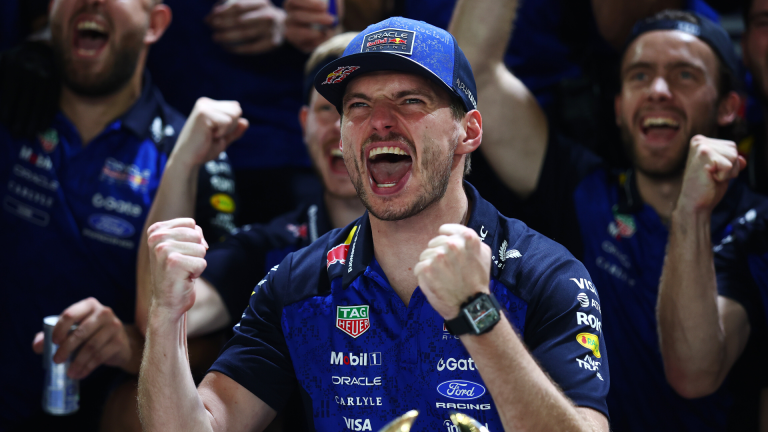
Leclerc qualified second, with Hamilton third, giving the Scuderia an opportunity to challenge Max Verstappen’s Red Bull.
Ferrari also demonstrated competitive pace during the race, but its two drivers followed different tyre strategies.
Hamilton started on medium tyres, while Leclerc selected the soft compound. The decision reflected uncertainty about tyre performance after a weekend affected by limited dry running and changing weather conditions.
However, the medium tyres proved less effective than Ferrari expected, forcing Hamilton into an earlier stop.
The decisive moment came during a Virtual Safety Car period. Leclerc entered the pits, but Hamilton remained on track despite Ferrari intending to bring both cars in. Vasseur subsequently confirmed that the team had called both drivers to stop.
Hamilton missed the pit entry and continued on a strategy that ultimately left him sixth, while Leclerc secured second place. The seven-time world champion later accepted responsibility and apologised to Ferrari.
The incident cost the team an opportunity to place both cars on the podium.
However, Singapore should not be treated simply as another strategic error by Ferrari’s pit wall.
The team’s instruction was for Hamilton to stop, and the driver did not enter the pit lane. The available evidence therefore distinguishes the incident from situations in which Ferrari itself selected an unsuccessful strategy.
That distinction is essential when evaluating Vasseur’s management.
Hamilton and Leclerc have repeatedly questioned Ferrari’s decisions
Singapore was not an isolated episode of frustration involving Ferrari’s drivers.
At Zandvoort, Hamilton questioned why the team had not intervened more quickly when he believed he was faster than Leclerc.
The Briton argued that his strategy was being compromised by remaining behind his team-mate, while Ferrari delayed issuing instructions to change their positions.
At Monza, the two drivers came close to contact during an aggressive opening-lap battle, creating further discussion about the rules governing their on-track cooperation.
At Sepang, Hamilton rejected Ferrari’s preferred tyre strategy in changing conditions and ultimately recovered to finish third.
Leclerc also questioned the team’s decisions during the Malaysian weekend.
The incidents involved different circumstances, and they cannot all be attributed to the same operational failure.
Nevertheless, the repeated public disagreements indicate that Ferrari has not consistently established confidence between its drivers and strategic decision-makers.
The issue is particularly important because Hamilton and Leclerc are both established drivers who expect to compete for victories.
Neither is naturally suited to a permanent supporting role, requiring Ferrari to manage competing sporting interests without sacrificing championship points.
As previously examined by GRANDE PRÊMIO, Ferrari’s recurring disagreements over strategy and driver cooperation have exposed a broader problem of trust.
Does Ferrari have a recurring problem under Vasseur?
The championship statistics suggest two different patterns. The first concerns competitiveness.
Ferrari improved significantly between 2023 and 2024, suffered a substantial regression in 2025 and recovered much of its performance in 2026.
There is no evidence of a continuous decline across Vasseur’s four seasons. Instead, the team’s results have fluctuated sharply.
The second pattern concerns execution. Even during periods when Ferrari has demonstrated strong pace, strategic disagreements and operational mistakes have prevented the team from consistently converting performance into the maximum possible results.
The problem has become particularly visible in 2026 because Ferrari is regularly competitive enough to fight for podium positions.
A strategic error costs more when the car is capable of finishing second or third than when it is struggling outside the leading group.
That helps explain why criticism of Vasseur has not disappeared despite Ferrari’s improved results. The Scuderia is closer to the front, but expectations have increased accordingly.
Christian Horner speculation creates another problem for Vasseur
Vasseur’s position has also attracted attention because of speculation linking former Red Bull team principal Christian Horner with Ferrari.
Horner left Red Bull in July 2025 after two decades leading the organisation. His record includes eight Drivers’ Championships and six Constructors’ titles, making him one of the most successful team principals in Formula 1 history.
The possibility of his return has inevitably generated discussion about potential opportunities at leading teams.
Ferrari has been mentioned because of its status, resources and continuing ambition to end its championship drought.
However, there is no confirmed agreement for Horner to replace Vasseur, and Ferrari has publicly supported its current team principal.
Horner has also indicated that any return to Formula 1 would ideally involve a project in which he could hold an ownership interest, a condition that would be difficult to accommodate within Ferrari’s existing structure.
The former Red Bull boss recently revealed that Oliver Mintzlaff contacted him to acknowledge his contribution to Red Bull’s power-unit programme after Verstappen’s victory at Sepang.
The conversation was another indication that Horner remains connected to developments in Formula 1, despite no longer holding an operational position.
The speculation creates additional external pressure on Vasseur, but it should not be confused with evidence that Ferrari has decided to change its leadership.

Vasseur’s strongest defence is also Ferrari’s biggest frustration
The numbers provide Vasseur with a substantial argument in his favour.
Ferrari has recovered from a difficult 2025 campaign, returned to second place in the Constructors’ Championship and increased its average points per race weekend. The team has also reduced its deficit to the championship leader compared with last season.
However, the same statistics demonstrate that Ferrari remains further from the top than it was in 2024.
The Scuderia has improved without recovering its strongest relative competitive position under Vasseur. That distinction is central to understanding the pressure on the Frenchman.
A team that finishes second after a major recovery can reasonably argue that its development programme is working. But Ferrari is judged against the objective of winning championships, not simply improving on the previous season.
Its challenge is intensified by the performance of Mercedes and Red Bull.
Mercedes has dominated much of 2026, while Verstappen’s consecutive victories in Malaysia and Singapore suggest Red Bull has made substantial progress. The recovery of Red Bull and its implications for the 2027 championship create another concern for Ferrari as it prepares for next season.
What Ferrari’s four seasons reveal about Vasseur’s future
The four-year comparison does not support a simple verdict that Vasseur has failed to improve Ferrari.
The team has produced two substantial recoveries, in 2024 and 2026, separated by a disappointing regression in 2025. It has also shown that competitive progress can disappear quickly when a rival develops more effectively or Ferrari fails to maximise its own potential.
The strongest criticism of Vasseur therefore concerns the absence of sustained championship-level performance, rather than an inability to produce any improvement. Ferrari has not established the consistency required to remain close to the leading constructor across consecutive seasons.
The recurring strategic disputes involving Hamilton and Leclerc have added another dimension to that concern, particularly when they result in lost positions or public disagreement.
Yet the available evidence also makes it difficult to attribute every mistake to the team principal. Singapore, for example, involved a missed pit entry by Hamilton rather than a decision by Ferrari to leave him on track.
The numbers suggest that Vasseur has made Ferrari competitive again, but has not yet demonstrated that he can keep it consistently competitive enough to win a championship.
That is the distinction between the recovery shown in the 2026 standings and the expectations that continue to define his position at Maranello.
Ferrari’s next opportunity comes at the United States Grand Prix, scheduled for October 23–25 at the Circuit of The Americas. The complete Austin schedule and international start times are available on GRANDE PRÊMIO.