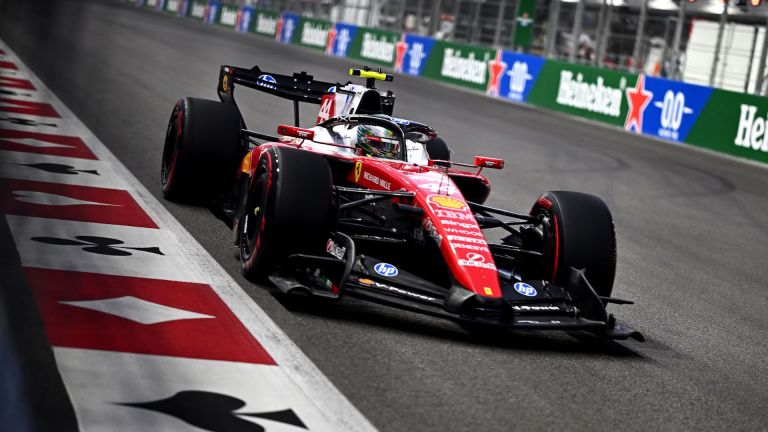
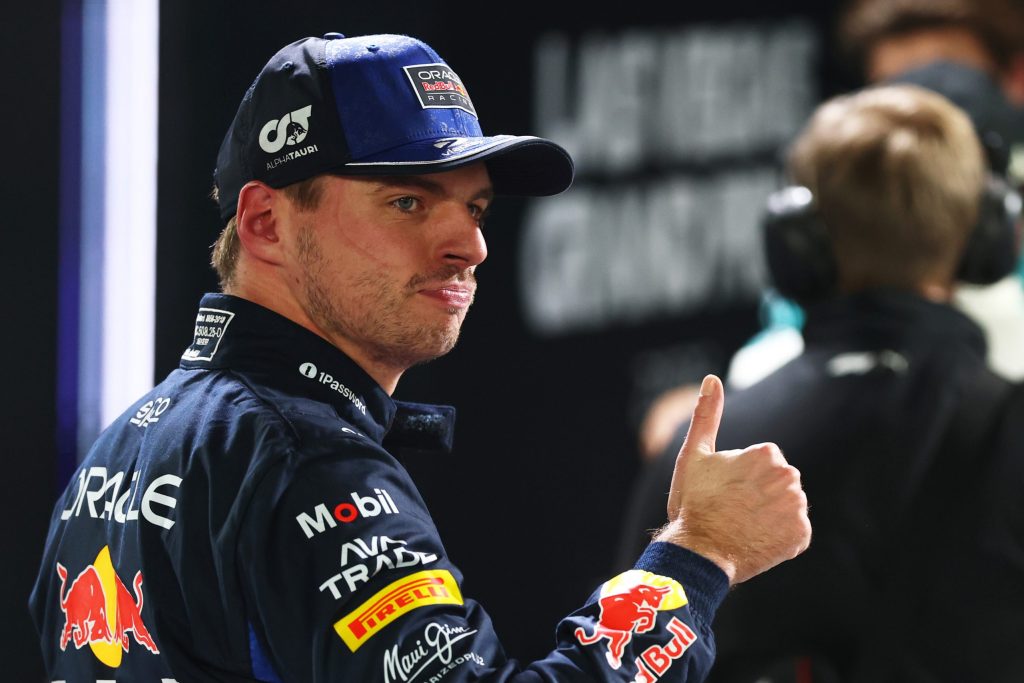
News Summary
- Max Verstappen starts the Las Vegas Grand Prix from pole, although Kimi Antonelli was 0.258 seconds faster in qualifying and George Russell joins him on the front row.
- Mercedes demonstrated impressive dry-weather pace, but Russell believes the team still needs answers about its tyre performance, while Red Bull has not fully resolved Verstappen’s balance complaints.
- Lando Norris starts third despite McLaren’s poor straight-line speed, with tyre graining and the timing of a likely single pit stop potentially influencing the fight for victory.
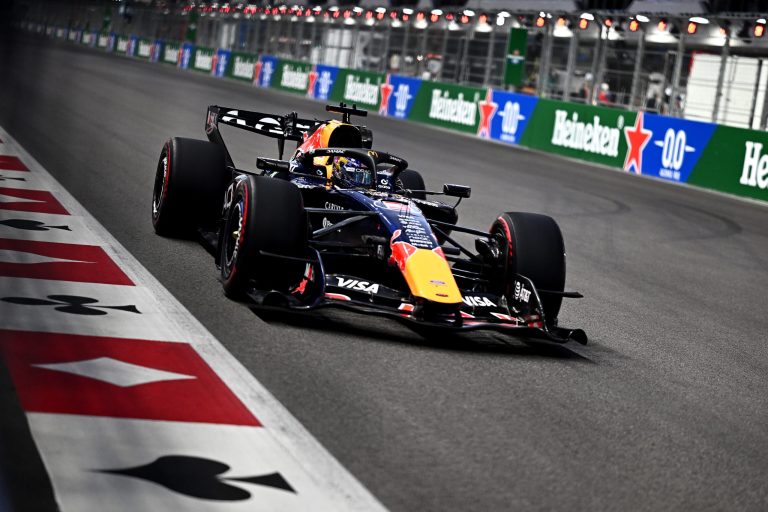
Max Verstappen has pole position for the 2026 Las Vegas Grand Prix, but the circumstances behind his place at the front of the grid leave an important question unanswered: does Red Bull actually have the fastest car for Saturday night’s race?
The Dutchman qualified second with 1:34.151, finishing 0.258 seconds behind Kimi Antonelli. However, the Mercedes driver’s five-place penalty for using his sixth internal combustion engine promoted Verstappen to pole, with George Russell moving into second.
Russell qualified just 0.073 seconds behind Verstappen, while Lando Norris was another 0.020 seconds slower. Those narrow margins suggest an intense fight at the front, but qualifying pace cannot be directly converted into a prediction about race performance.
The problem is that the teams have remarkably little representative information about how their cars will perform over a full dry-weather stint.
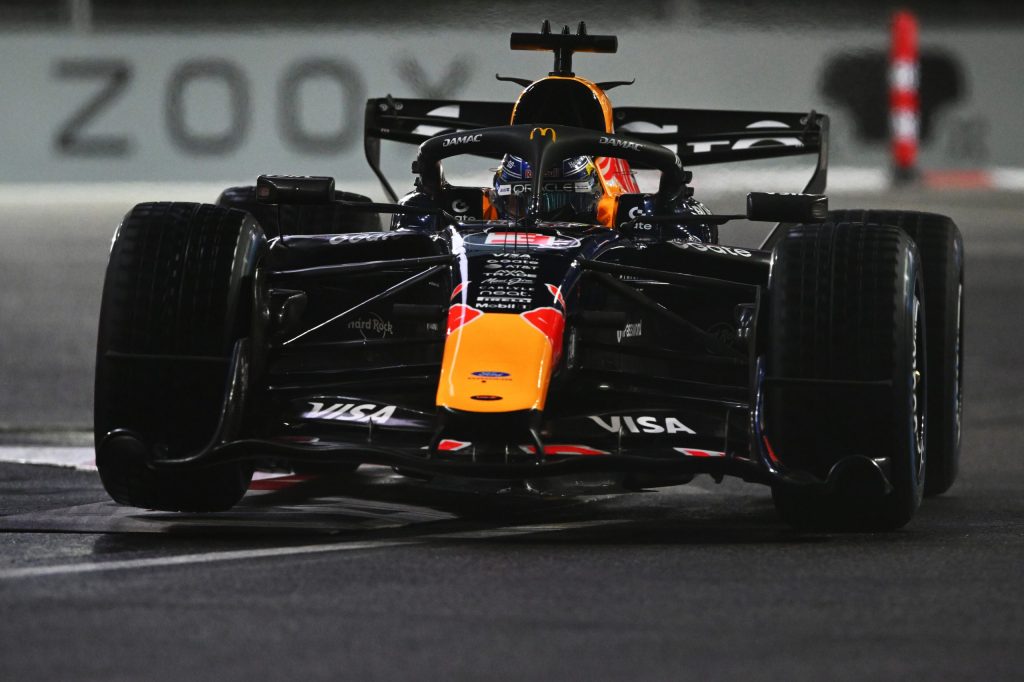
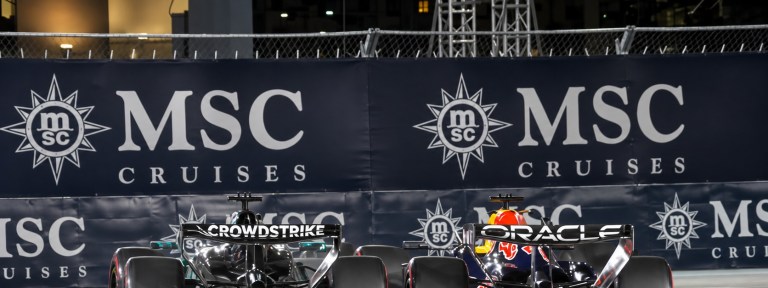
Mercedes has the speed, but can Russell convert it into victory?
Mercedes delivered the strongest evidence of outright performance during the final stages of the weekend.
Russell topped FP2 in wet conditions and then dominated FP3 on a dry circuit, recording 1:34.041, more than nine tenths faster than Antonelli in second.
The result established Russell as one of the favourites for qualifying, although the final session produced a different outcome.
Antonelli found a substantial advantage through the slipstream on his final attempt and recorded the fastest lap, while Russell failed to improve sufficiently.
Mercedes team principal Toto Wolff admitted that the team did not fully understand how Antonelli had produced such a remarkable lap while running so close to Arvid Lindblad.
“We have absolutely no clue,” Wolff said after qualifying.
Russell, meanwhile, believes Mercedes’ underlying performance gives it reason for optimism.
“Overall it’s been a very solid session and a solid day,” the British driver explained.
“Obviously, I wanted to be on pole, but I’m probably more pleased with the performance today than I was maybe in, let’s say, Mexico a couple of weeks ago when I was on the front row.”
That assessment is significant. Russell was satisfied with the car’s competitiveness even without the fastest qualifying time.
The main concern for Mercedes is whether its speed over a single lap will translate into consistent race pace.
The team experienced excessive oversteer during the wet sessions, with its rear tyres operating at higher temperatures than the fronts. The conditions improved for qualifying, but there has been little opportunity to establish how the car behaves over longer dry runs.
Russell has also highlighted the uncertainty surrounding tyre graining and whether the race will require one or two pit stops.
The ability to manage those tyres could prove more important than Mercedes’ qualifying advantage.
Verstappen admits Red Bull has not solved its problems
Red Bull’s performance improved substantially between the opening practice sessions and qualifying.
Verstappen completed just eight laps in FP2, finishing 13th as balance problems and energy-management difficulties complicated the team’s programme.
Technical director Pierre Waché subsequently explained that the car’s handling was a bigger concern than the electrical deployment issues.
However, Verstappen revealed after qualifying that some of those problems were not new.
“Just struggling with some things that also were in the car in Brazil,” he admitted.
“Just trying to get my head around to it to try to make the best out of it this weekend again.”
Despite those difficulties, Verstappen praised Red Bull’s execution and acknowledged the importance of the slipstream during qualifying.
“I think we had a solid qualifying. We executed well. My first lap in Q3 was pretty much as good as it can be, just with the tow effect as well around the lap,” he said.
“I think to be on the front row is very good for us.”
The result leaves Red Bull in an unusual position. Verstappen has the best starting place without having demonstrated the strongest outright qualifying pace, while the team admits that some of its handling difficulties remain unresolved.
Its race performance will depend on whether the setup allows Verstappen to manage tyre temperatures consistently and defend against the Mercedes behind him.
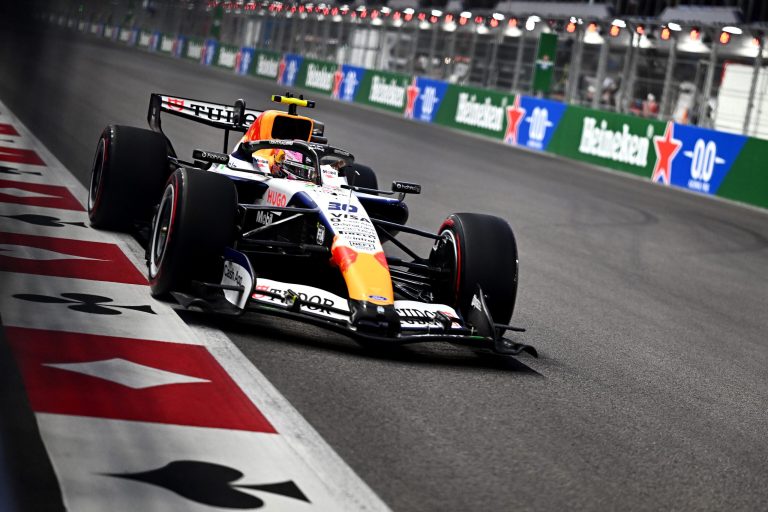
Red Bull also has Isack Hadjar starting fourth. The Frenchman believes the car is competitive through the corners and on the straights, giving him confidence that a podium is possible.
That provides Red Bull with a second car capable of influencing the battle near the front.
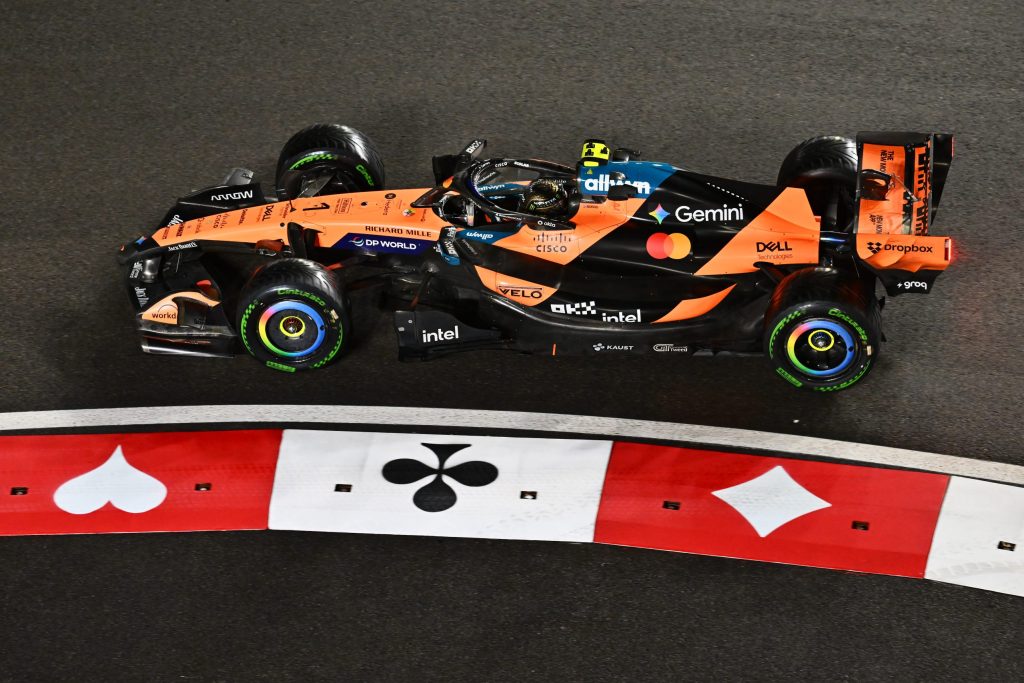
Norris starts third, but McLaren’s straight-line weakness is a major concern
Lando Norris begins the Grand Prix from third place, just behind Verstappen and Russell, but the McLaren driver has expressed serious doubts about his car’s competitiveness.
Norris admitted that McLaren’s aerodynamic compromise is costing substantially more time along the straights than it gains through the corners.
“We lose a lot more in the straights than we get in the corners and this is certainly not the track you’ll need to be like this,” he explained after qualifying.
The British driver considers the problem particularly damaging at Las Vegas, where long acceleration zones dominate the lap.
He also expects the race to expose the weakness.
“I think a good result is still possible, but it’s gonna be insanely tough,” Norris said.
“Yeah, we’re one of the slowest in the straights. So it’s gonna be nasty.”
That creates a potential problem at both ends of McLaren’s race. Norris may struggle to attack Verstappen and Russell while also being vulnerable to drivers approaching from behind with a straight-line advantage.
Hadjar has already identified the McLaren’s weakness as an opportunity, openly targeting a podium from fourth place.
McLaren could still benefit from superior tyre management or cornering performance, but Norris’ comments make it difficult to regard him as the obvious favourite despite his strong grid position.
The team’s preparation was also disrupted when rain prevented it from evaluating a revised aerodynamic floor during FP2.
The full implications of those development choices remain difficult to establish from the available running.
Antonelli starts sixth but could still be a major contender
Antonelli’s performance complicates the picture further.
The Mercedes driver was the fastest qualifier, beating Verstappen by more than a quarter of a second, but starts sixth because of his engine penalty.
That places him behind several cars that were slower in qualifying, including Norris, Hadjar and Lindblad.
However, Antonelli is confident that Mercedes can challenge for victory.
“I felt like the race pace was strong in [practice], it felt good and the tyres felt in a good place,” the Italian said.
“So I think we’ll have a good chance tomorrow to fight for hopefully the win.”
The difficulty will be recovering positions without losing too much time behind slower cars.
The powerful slipstream available in Las Vegas could help Antonelli attack, but his ability to overtake will depend on the performance difference between the cars, tyre temperatures and energy deployment.
His recovery also presents Mercedes with two different tactical situations: Russell can challenge Verstappen immediately from the front row, while Antonelli may need a more aggressive approach to regain positions.
Will one pit stop make Verstappen harder to beat?
Pirelli expects one pit stop to be the fastest strategy in Las Vegas, although low temperatures and the possibility of graining could create opportunities for alternative approaches.
The tyre supplier has selected C3, C4 and C5 for the weekend, with the medium and soft compounds among the likely options.
The unusual problem is that newly fitted tyres may lose temperature along the long section after the pit exit, reducing the normal effectiveness of the undercut.
That could favour drivers who remain on track with tyres already operating in the correct temperature window.
For Verstappen, protecting track position could therefore be particularly valuable if the race follows the expected one-stop pattern.
A two-stop race would create more opportunities for rivals to change strategy and exploit differences in tyre performance.
Safety Car interruptions could also reshape the competition, especially if drivers have already begun experiencing graining.
Without reliable long-run comparisons, it is not possible to establish which of the leading teams will manage those conditions most effectively.
The starting order and the teams’ contrasting strengths are nevertheless clear.
| Driver | Start | Main advantage | Main uncertainty |
|---|---|---|---|
| M. VERSTAPPEN | 1st | Pole position and Red Bull straight-line performance | Balance issues |
| G. RUSSELL | 2nd | Strong dry FP3 pace and Mercedes speed | Tyre management over long stints |
| L. NORRIS | 3rd | Strong qualifying position and cornering performance | Straight-line speed deficit |
| K. ANTONELLI | 6th | Fastest qualifying lap and Mercedes performance | Recovering positions after penalty |
The full starting grid and GRANDE PRÊMIO’s report on Verstappen’s unresolved Red Bull problems provide the background to the race.
Verstappen has the advantage of starting first. Mercedes has the strongest evidence of qualifying speed. McLaren is competitive through the corners but faces a deficit on the straights. Antonelli has the fastest lap, but not the starting position to match.
That is why Verstappen’s pole position does not establish that Red Bull has the best car to win in Las Vegas.
The 50-lap Grand Prix begins at 8:00 PM local time on Saturday, November 21, corresponding to 11:00 PM Eastern Time and 4:00 AM GMT on Sunday, November 22.
GRANDE PRÊMIO is following every session of the Las Vegas Grand Prix and the latest developments in Formula 1.
FAQ
Is Max Verstappen the favourite to win the 2026 Las Vegas Grand Prix?
Verstappen benefits from pole position, but Mercedes showed stronger outright qualifying pace. Limited dry-weather long runs make a definitive comparison of race performance impossible.
Why could George Russell challenge Verstappen in Las Vegas?
Russell starts second and topped dry FP3 by a substantial margin. Mercedes also recorded the fastest qualifying lap through Antonelli, although its long-run tyre performance remains uncertain.
Can Kimi Antonelli win despite starting sixth?
Antonelli believes Mercedes has competitive race pace. However, he must recover positions after his five-place grid penalty, making overtaking opportunities and tyre strategy important to his chances.