
Andrea Kimi Antonelli’s extraordinary victory at the Italian Grand Prix on Sunday (6) will inevitably be linked to Mercedes’ decision to give him a different strategy from George Russell. The late pit stop under the Virtual Safety Car gave the Italian a fresh set of medium tyres for the final 24 laps and ultimately proved crucial in the fight for victory. But the lap times from the entire weekend suggest the strategy was not the only explanation for Antonelli’s performance at Monza.
Starting 19th after taking a grid penalty for power-unit component changes, Antonelli recovered all the way to the lead before the VSC. He eventually passed Russell for good on lap 50 and became the first Italian to win the Italian GP since Ludovico Scarfiotti in 1966. GRANDE PRÊMIO detailed the historic comeback from the back of the grid.
So, would Antonelli have won without the extra stop?
There is no way to say for certain. But the evidence suggests that he had the pace to fight for victory — while the fresh tyres made the final overtake possible.
The race pace was already there on Friday
The foundations of Antonelli’s performance were laid well before Sunday.
Mercedes knew from the Dutch GP that Antonelli would have to start from the back at Monza because of the power-unit penalty. That made race pace particularly important, and the Italian had already shown encouraging long-run performance during Friday practice.
In FP2, Antonelli completed a 12-lap long run on the hard tyre with an average lap time of 1:26.063. Seven of those laps were in the 1:25s, with times ranging from 1:25.9 to 1:25.7.
Russell, meanwhile, completed a seven-lap hard-tyre run with an average of 1:26.101, although the shorter stint and different fuel loads make a direct comparison imperfect.
The important point was that Antonelli was already demonstrating the consistency Mercedes would need on Sunday.
Max Verstappen’s medium-tyre long run was slightly slower at 1:26.377, while Russell’s hard-tyre simulation was around two-tenths quicker. The difference was small enough to suggest Mercedes had a particularly strong race car at Monza.
Qualifying revealed an important strategic difference
Antonelli’s qualifying performance further complicated Mercedes’ strategy picture.
The Italian reached Q3 and helped Russell with a tow during the final phase of qualifying, but the most important detail for Sunday was hidden in the tyre allocation.
Antonelli arrived at the race with two new sets of medium tyres, while Russell had only one. Antonelli also had no new soft set available.
That difference mattered.
For Russell, who started from the front row, Mercedes’ tyre allocation effectively pointed towards a one-stop race. Antonelli, starting near the back, needed greater strategic flexibility.
The difference became decisive after the red flag.
Antonelli’s first stint changed everything
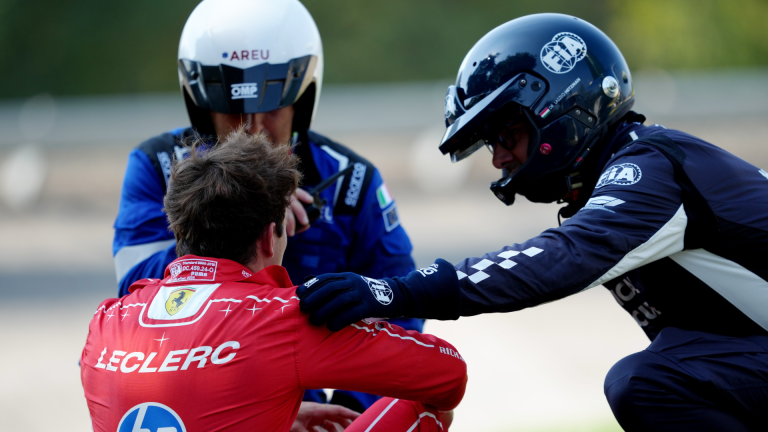
Antonelli started the original race on hard tyres, but the early red flag following Charles Leclerc’s heavy crash at the Parabolica meant the strategy had to be reconsidered.
At the restart, most of the leading drivers were on hard tyres, while Verstappen, Hamilton and Antonelli were on mediums.
Antonelli started 12th and immediately attacked.
After another strong launch, he moved from 12th to eighth and gained roughly 3.5 seconds on Russell in four laps, an average advantage of around 0.8s per lap during that period.
The Italian then continued to carve through the field.
By lap 13, Antonelli had passed Oscar Piastri. Three laps later, he overtook Verstappen for second. On lap 18, he passed Russell for the lead. The race notes show that Antonelli was already setting the fastest laps as he climbed through the field.
That is the first major argument against the idea that the victory was simply a product of strategy.
Antonelli had already reached the front before the Mercedes pit-wall decision under the VSC.
Russell was faster than expected — but could not escape
Russell’s hard tyres also performed better than Mercedes’ Friday simulation suggested.
After the first exchanges, the Briton regained the lead and spent much of the middle phase of the race ahead of Antonelli.
The two Mercedes drivers repeatedly swapped positions, with Russell eventually establishing a small advantage.
But there was an important limitation: Russell could not pull clear.
Even when he led, Antonelli remained close enough to attack again. Mercedes eventually asked the Italian to stop the repeated attacks and give Russell some breathing room so both cars could create a gap over the rest of the field.
That gap never became large enough to make the outcome comfortable.
At the halfway point, Russell led Antonelli by only around 0.2s, with Verstappen 1.2s behind.
The VSC was the turning point
The decisive moment arrived on lap 28.
Russell was leading Antonelli by around half a second when Lance Stroll’s stoppage triggered the Virtual Safety Car.
This was the opportunity Mercedes had been waiting for.
Antonelli still had a fresh set of mediums available, so Mercedes brought him into the pits. He rejoined sixth, with 24 laps remaining.
Russell stayed out on his original hard tyres and, from that moment, the strategic equation changed completely.
There was no comparable fresh-tyre option left for Russell if another VSC appeared.
Mercedes later explained that Russell effectively had no alternative once Antonelli stopped.
The lap times give the clearest answer
This is where the argument becomes particularly interesting.
In the 18 laps after his stop, Antonelli was on average around 0.5s per lap faster than Russell.
The difference was not created solely by the tyres. Fuel loads were falling, track conditions were evolving and Russell was increasingly managing a worn hard compound.
But the advantage was substantial.
By lap 40, Russell was still 7.3s ahead. Three laps later, that gap had fallen to 4.7s.
Antonelli then began taking chunks out of the deficit.
On lap 44, he set the fastest lap in 1:24.037.
The following lap, he improved to 1:23.861, cutting the gap to just 1.5s.
Russell was also reporting tyre vibration and was told by Mercedes simply to bring the car home.
Antonelli finally caught him on lap 49. After both drivers ran wide in the first chicane sequence, the Italian remained within 0.8s.
One lap later, he made the decisive move at Ascari.
He then pulled away to win by 3.857s.

So, would Antonelli have won without the second stop?
The most honest answer is probably not — at least not in the same way.
Without the fresh-medium stop, Antonelli would have been forced to manage the tyres used during his first stint for much longer. His pace was already exceptional, but asking those tyres to cover the remaining distance would have created a completely different race.
The VSC therefore gave Mercedes an opportunity to reset Antonelli’s tyre strategy and, crucially, put him on a compound that was capable of delivering qualifying-like pace late in the race.
But saying “Antonelli only won because of the pit stop” would also miss the bigger picture.
He started 19th.
He was 12th after the restart.
He reached the lead by lap 18.
He repeatedly fought Russell without losing contact.
He maintained enough tyre performance to attack throughout the first stint.
And after the stop, he produced the pace necessary to erase a seven-second deficit and overtake his teammate for the win.
GRANDE PRÊMIO’s analysis of the Italian GP showed just how much the race exposed Mercedes’ advantage at Monza.
The strategy opened the door.
Antonelli’s pace was what allowed him to walk through it.
Mercedes also deserves credit for choosing Monza as the ideal venue for Antonelli to take the power-unit penalty. The circuit’s long straights and overtaking opportunities made a recovery from the back far more realistic than it would have been at a track where track position is harder to overcome.
In the end, the lap times tell a story that is more complicated than strategy versus pace.
The extra stop probably turned a potential podium — or even a difficult fight for victory — into a win. But Antonelli had already demonstrated enough raw speed to make the strategy worth betting on.
Formula 1 now heads to Madrid for the Spanish Grand Prix from September 11-13. The new Madring street circuit will host the 14th round of the 2026 season, with Antonelli arriving as championship leader by 66 points over Russell. GRANDE PRÊMIO will follow all the action from Madrid.
FAQ
Did Antonelli win the Italian GP because of Mercedes’ strategy?
The late VSC pit stop was crucial because it gave Antonelli fresh medium tyres for the final phase, but his pace was already strong enough to reach the lead before the stop and remain in contention throughout the race.
How many positions did Antonelli gain at the 2026 Italian GP?
Antonelli started 19th and won the race, gaining 18 positions — the second-lowest starting position from which a driver has won an F1 Grand Prix. GRANDE PRÊMIO has the full historical context of his comeback.
What is Antonelli’s championship lead after the Italian GP?
Antonelli leads the 2026 F1 drivers’ championship by 66 points over Mercedes teammate George Russell, with 267 points to Russell’s 201 after 13 rounds.