Formula 1 is preparing to restore its traditional 305km Grand Prix distance in 2028, ending the shorter 290km race format after just one season, according to the latest regulatory changes covering the championship’s next technical cycle. The decision represents a reversal of the temporary reduction introduced to accommodate increased fuel consumption under the revised hybrid power-unit regulations.
Article B2.5.2 of the proposed 2028 Sporting Regulations establishes that a Grand Prix must cover the smallest number of complete laps exceeding 305km, restoring the standard distance used before the reduction planned for 2027. Monaco remains an exception, with a minimum distance exceeding 260km.
The change follows Formula 1’s decision to reduce standard Grand Prix distances from 305km to 290km in 2027, a measure designed to accommodate higher fuel-energy flow without requiring teams to make immediate and costly modifications to their fuel tanks.
The newly identified 2028 provision indicates that the shorter format is intended to be temporary, with the traditional distance returning as teams adapt their cars to the next stage of the technical regulations.
F1 plans to restore 305km races after one season
The proposed 2028 regulation appears in Article B2.5.2, under the section covering race-session distance. The provision establishes that the scheduled distance must exceed 305km, with the exact number of laps determined by the length of each circuit.
The exception for Monaco remains unchanged, preserving its shorter distance of approximately 260km because of the characteristics of the street circuit. The regulation also allows adjustments when formation laps take place behind the safety car.
The return to 305km contrasts with the decision taken by the Formula 1 Commission in September, when teams agreed to shorten standard Grands Prix by approximately 15km for 2027.
The reduction to 290km is expected to remove two or three laps from most Grands Prix, depending on circuit length. At Austin, for example, the United States Grand Prix is projected to fall from 56 laps to 53 in 2027, assuming the existing layout and calculation method remain unchanged.
Restoring the 305km threshold in 2028 would bring the race back towards its traditional lap count.
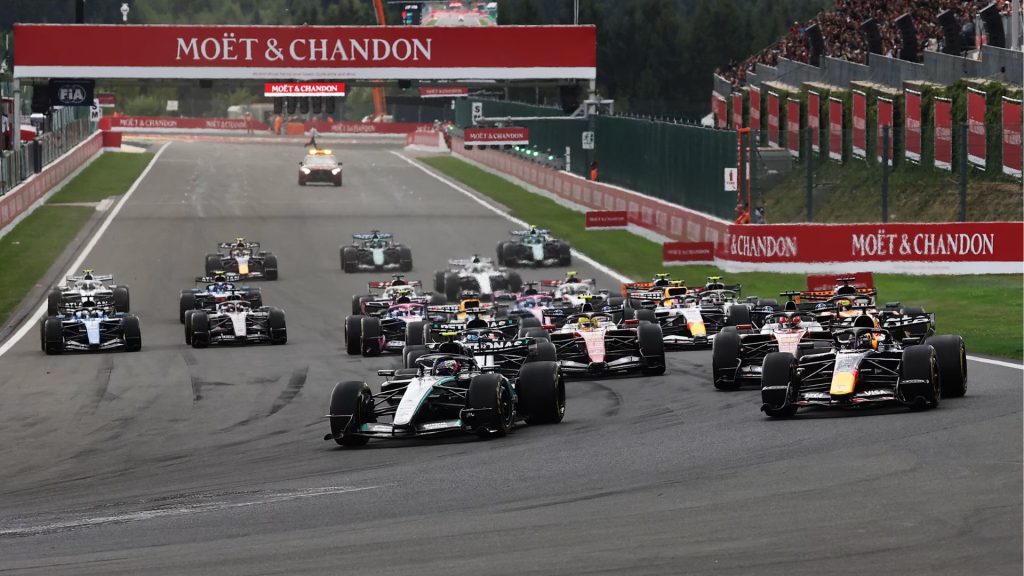
Why Formula 1 decided to shorten races for 2027
The decision to reduce race distances was directly connected to changes in the balance between combustion and electrical power. Formula 1 introduced new hybrid power units in 2026, significantly increasing the contribution of the electrical system.
However, the regulations created difficulties involving energy management, with drivers frequently required to conserve or recover electrical energy during qualifying and races. The FIA subsequently agreed to increase the contribution from the internal combustion engine over the 2027 and 2028 seasons.
That decision will increase fuel-energy flow and potentially fuel consumption, creating additional challenges for teams attempting to complete a full Grand Prix distance.
Rather than require every manufacturer to redesign its fuel tank immediately, all 11 Formula 1 teams supported the reduction to 290km for 2027. The compromise allows teams to accommodate the initial increase in combustion-engine output without making substantial changes to chassis designs introduced only one year earlier.
The Formula 1 Commission subsequently approved the measure, although the changes remained subject to the formal regulatory process.
F1 engine regulations: What changes between 2026 and 2028?
The wider regulatory package gradually increases the role of the combustion engine while reducing maximum electrical deployment.
| Technical parameter | 2026 | 2027 | 2028 |
|---|---|---|---|
| Standard Grand Prix distance | 305km | 290km | 305km proposed |
| Maximum ICE power | 400kW | 420kW | 450kW |
| Fuel-energy flow | Baseline | +5% | +13% |
| Maximum MGU-K output | 350kW | 300kW | 300kW |
The 2028 distance reflects the regulatory amendment presented. Fuel-energy-flow percentages refer to the announced technical package and should not be interpreted as an identical increase in actual fuel consumption.
The internal combustion engine’s contribution will increase in two stages, reaching approximately 450kW in 2028, equivalent to 603 horsepower. Meanwhile, the maximum MGU-K output will decrease from 350kW to 300kW.
The changes are designed to reduce some of the extreme energy-management demands associated with the original 2026 power-unit concept. However, the higher contribution from combustion power creates a different challenge: ensuring that cars carry sufficient fuel to complete a Grand Prix without excessive fuel saving.
That concern was central to the original decision to shorten races.
Will Formula 1 need larger fuel tanks in 2028?
The return to 305km races could force teams to reconsider fuel-tank capacity, particularly because the 2028 regulations are expected to permit higher combustion-engine output and fuel-energy flow than in 2026.
A longer race requires more total energy unless improvements in efficiency or changes in operating strategy compensate for the additional distance. Teams designed their 2026 cars around the original hybrid regulations, with fuel tanks integrated into tightly packaged chassis.
Increasing tank capacity can affect several areas of the car, including the survival cell, weight distribution, aerodynamic packaging and overall vehicle mass. Additional fuel would also influence the car’s performance at the beginning of races, when drivers are operating with their heaviest fuel loads.
However, the 2028 sporting provision does not explicitly require teams to increase fuel-tank size. Manufacturers could potentially respond through a combination of greater capacity, improved efficiency and revised energy-management strategies.
The final solution will depend on the technical regulations and the fuel consumption characteristics of each power unit.
The distinction matters because the return to 305km establishes a sporting requirement, while the engineering response remains a separate question.
Hamilton had already questioned shorter F1 races
The decision to shorten races for 2027 attracted criticism from several drivers, including Lewis Hamilton. The seven-time world champion questioned whether reducing Grand Prix distances was appropriate at a time when Formula 1 cars had become less physically demanding to drive.
Hamilton argued that modern Formula 1 had become physically easier, although other drivers have described a different difficulty associated with the 2026 regulations: the increased mental workload required to manage energy deployment, battery recovery and changing power delivery.
The FIA’s technical revisions are intended to address some of those concerns by allowing drivers to rely more heavily on combustion power.
The planned restoration of the 305km distance in 2028 would also preserve the traditional length of Grands Prix, although it would not necessarily return the cars to the same physical or technical characteristics seen before 2026.
Longer races return alongside other regulatory changes
The distance adjustment forms part of a broader revision of Formula 1’s sporting and technical framework. For 2027, the championship has also approved changes to the rules governing interrupted races and gearbox development.
Formula 1 will remove the existing three-hour overall race limit and abandon gearbox homologation for 2027, giving manufacturers greater freedom to develop their transmissions while introducing revised procedures for races affected by interruptions.
Those changes accompany the revised power-unit regulations and the temporary reduction in race distance. The 2028 provision adds another stage to the transition, restoring the traditional Grand Prix distance after teams have had an additional season to adapt to the new engine requirements.