News Summary
- Ferrari arrives in Singapore after Lewis Hamilton and Charles Leclerc finished third and fourth at Sepang despite a compromised opening strategy
- Marina Bay places greater emphasis on low-speed performance, traction and mechanical grip, reducing the importance of some areas that limited Ferrari in Malaysia
- Singapore will reveal whether Ferrari’s Sepang pace represented a genuine late-season improvement or simply a favourable weekend
Ferrari left Malaysia believing it had missed an opportunity. Singapore may provide an even better one.
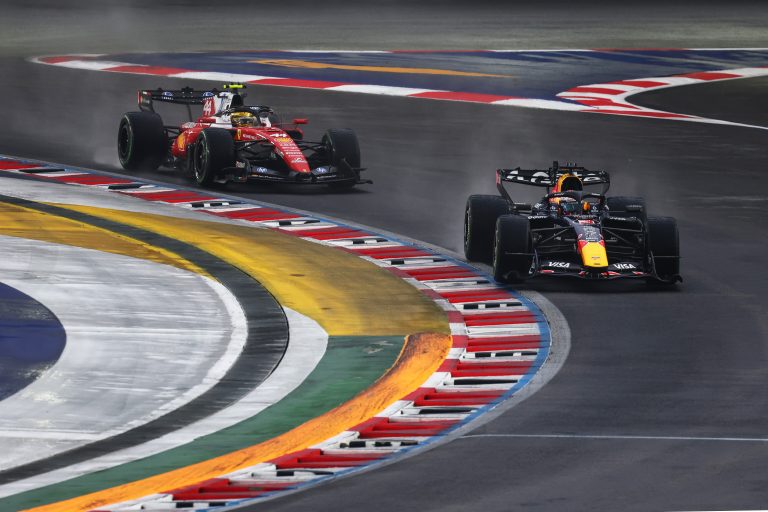
Lewis Hamilton qualified second at Sepang and recovered from more than one minute behind to finish third, while Charles Leclerc completed the race in fourth. Ferrari achieved that despite starting both cars on slick tyres when the circuit remained too wet, effectively removing them from the victory fight before conditions stabilised.
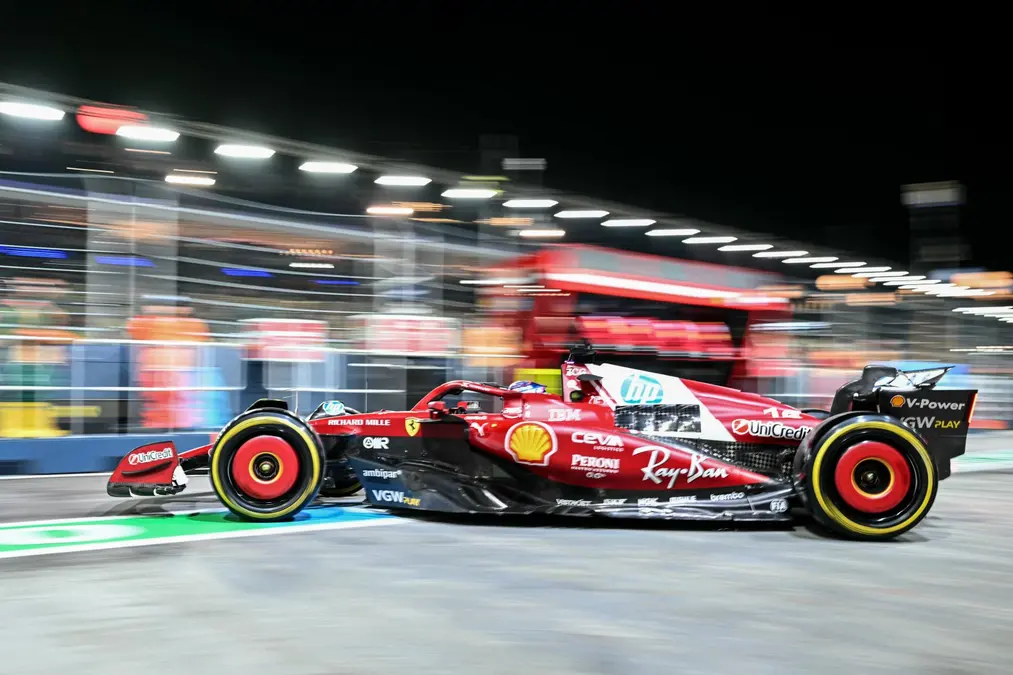
The underlying performance was nevertheless difficult to ignore. Hamilton had enough speed to qualify on the front row and Ferrari recovered both cars into the top four, giving the Scuderia its strongest indication in months that the SF-26 can operate close to the front.
As GRANDE PRÊMIO examined after the Malaysian weekend, Sepang raised the possibility that Ferrari has finally developed a car capable of challenging for victories again.
Marina Bay will test that argument on a completely different type of circuit — and several of its characteristics could work in Ferrari’s favour.
Singapore places less emphasis on one of Ferrari’s weaknesses
Sepang combines long straights with several medium and high-speed corners, forcing teams to find a difficult compromise between aerodynamic load and straight-line efficiency. Singapore asks a different question.
The Marina Bay Street Circuit is dominated by slow and medium-speed corners, short acceleration zones and repeated traction events, while the absence of Sepang-style long straights reduces the relative importance of outright aerodynamic efficiency. That distinction could matter for Ferrari.
The SF-26 has not consistently been the most efficient car in a straight line this season, particularly when Ferrari has increased downforce to improve stability through corners. At Marina Bay, the penalty for carrying additional aerodynamic load is generally less severe than at circuits dominated by long full-throttle sections.
Ferrari can therefore pursue a higher-downforce configuration without sacrificing as much lap time on the straights.
The potential benefit goes beyond aerodynamics. Singapore’s sequence of slow corners requires a car that gives drivers confidence under braking, rotates predictably at low speed and puts power down cleanly on corner exit. Those are areas in which Ferrari showed encouraging signs at Sepang even though the Malaysian circuit did not always allow the SF-26 to exploit them fully.
Hamilton’s Sepang qualifying provides an important clue
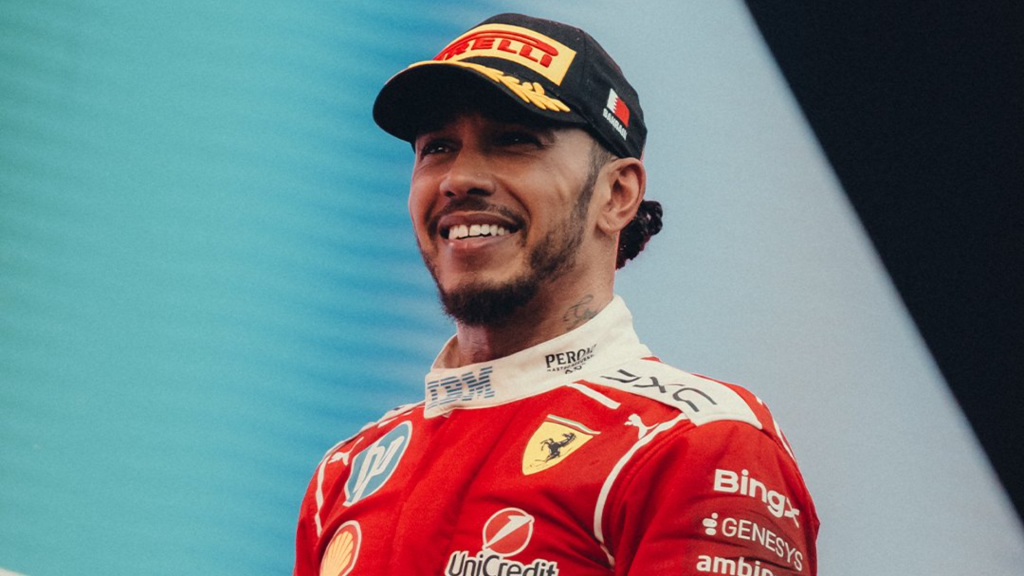
The strongest evidence came on Saturday. Hamilton put Ferrari on the front row, demonstrating that the SF-26 could generate competitive performance over a single lap even against Verstappen’s improved Red Bull.
That matters heading to Singapore because qualifying carries disproportionate importance at Marina Bay. Track position is valuable on a narrow street circuit where overtaking remains considerably more difficult than at Sepang.
Hamilton therefore does not necessarily need Ferrari to possess the outright fastest race car to become a serious victory threat. A strong qualifying performance could change the entire complexion of the weekend.
The same applies to Leclerc, whose qualifying ability has historically made him particularly dangerous on street circuits. Ferrari’s challenge will be converting that speed into a complete weekend rather than repeating the operational mistakes that undermined its opportunity in Malaysia.
Hamilton’s recovery from more than one minute behind at Sepang demonstrated what Ferrari could do after the damage had already been inflicted. Singapore offers an opportunity to discover what the SF-26 can achieve without needing a recovery at all.
Marina Bay will also test Ferrari’s mechanical grip
There is another major difference between the two circuits.
Sepang’s fast corners place enormous emphasis on aerodynamic performance, while Singapore requires considerably more from the car mechanically. Drivers repeatedly attack kerbs, negotiate bumps and accelerate from relatively low speeds, making suspension behaviour and rear traction critical.
Ferrari has traditionally been competitive when mechanical grip becomes particularly important, although past performance does not guarantee the SF-26 will reproduce that strength in 2026.
The surface itself creates another useful contrast. Sepang’s old and abrasive asphalt became one of the central explanations discussed after Mercedes unexpectedly struggled with its major upgrade. Antonelli pointed out that the W17 has repeatedly encountered difficulties on older surfaces this season.
Mercedes is now considering comparing different specifications in Singapore to establish how much of its Malaysian deficit came from the new package and how much was circuit-specific.
Ferrari faces a similar question from the opposite direction. If Hamilton and Leclerc remain competitive at Marina Bay, the argument that Sepang represented genuine Ferrari progress becomes substantially stronger.
Red Bull provides Ferrari’s real benchmark
Mercedes may lead both championships, but Ferrari left Sepang looking primarily at Red Bull.
Leclerc explicitly identified Verstappen’s pace as an important reference after the race, reflecting how quickly the competitive picture has changed.
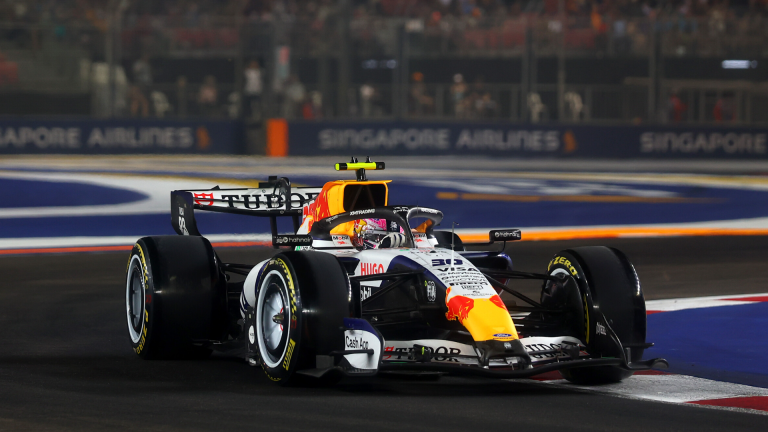
Red Bull introduced its final major aerodynamic upgrade around Azerbaijan and transformed that development into pole position and victory in Malaysia. Isack Hadjar’s competitiveness in the second RB22 strengthened the case that the improvement belonged to the car rather than simply another exceptional Verstappen performance.
Singapore now poses the same question to Red Bull that it does to Ferrari.
Marina Bay will reveal whether Verstappen’s Sepang victory was a genuine breakthrough or a one-off, because the slow-speed street circuit attacks areas in which the RB22 has struggled during 2026. That potentially creates an opportunity for Ferrari.
If Red Bull loses some of its Malaysian advantage in slower corners while Ferrari maintains its recent performance, the gap between them could narrow naturally.
Ferrari’s street-circuit strength offers another reason for optimism
Street circuits have provided Ferrari with useful reference points during the season because they often reward exactly the qualities required at Marina Bay: confidence under braking, low-speed rotation and traction.
Leclerc’s ability to extract lap time from the car in qualifying becomes particularly valuable in that environment, while Hamilton’s experience on circuits where rhythm and precision matter can also reduce the importance of small differences in outright car performance.
Singapore magnifies those factors because mistakes are punished immediately by walls and track evolution can dramatically alter grip levels between sessions.
The sprint format adds another complication in 2026. Teams have only one practice session before sprint qualifying, limiting the amount of time available to optimise setup. Ferrari therefore needs to arrive with a strong baseline rather than spend Friday experimenting with major changes.
That may actually help a team whose Sepang performance already provided a relatively clear direction.
Singapore can turn Ferrari’s promise into evidence
Sepang proved that Ferrari can be competitive. It did not prove that Ferrari has become a consistent race-winning team. Singapore can move that argument forward.
A strong weekend at Marina Bay would mean the SF-26 had challenged near the front at two fundamentally different circuits in consecutive races. That would be much harder to dismiss as track-specific performance.
It would also arrive at an important moment. Hamilton is third in the championship on 214 points, while Ferrari has seven rounds remaining to convert its late-season progress into something tangible. The title may be moving increasingly towards Antonelli, but race victories remain available.
Red Bull has already transformed development progress into a win. Ferrari now needs to do the same. Sepang showed what might be possible. Singapore is where the Scuderia can prove it.
GRANDE PRÊMIO follows all the latest Formula 1 news throughout the Singapore GP weekend.
FAQ
Why could Singapore suit Ferrari?
Marina Bay places greater emphasis on low-speed performance, traction and mechanical grip than Sepang, while its shorter straights reduce the relative importance of aerodynamic efficiency. Those characteristics could allow Ferrari to exploit some of the SF-26’s strengths.