News Summary
- Mercedes is considering a back-to-back comparison with its previous specification at the Singapore GP
- The Sepang upgrade was expected to deliver around 0.3s, but Toto Wolff estimated Mercedes instead appeared four or five tenths slower
- Kimi Antonelli says Mercedes still does not know whether the new package made the W17 faster or worse
Mercedes is considering using the Singapore GP to conduct a direct comparison between different versions of the W17 as it investigates why its major Formula 1 upgrade failed to produce the expected performance at Sepang.
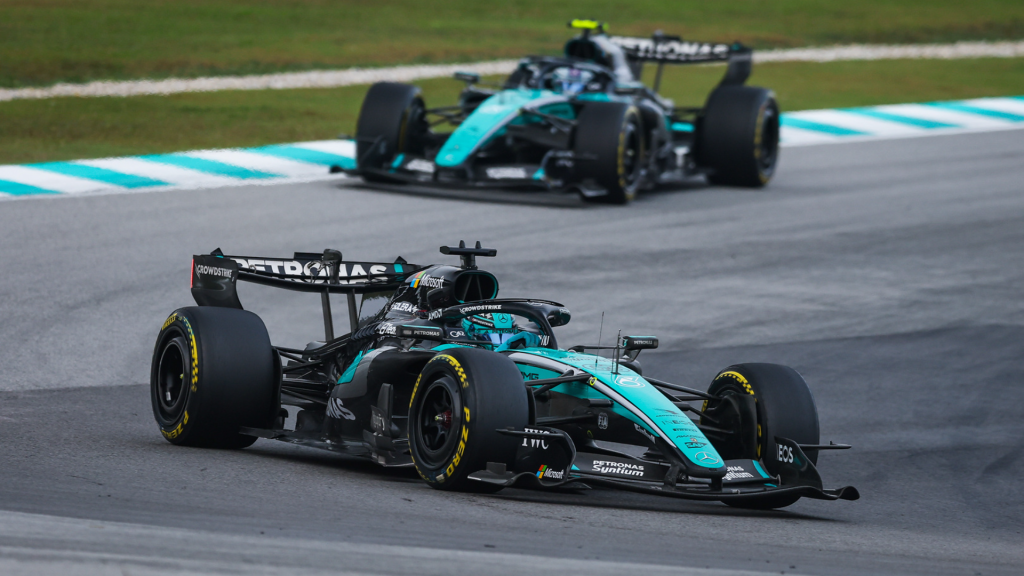
The team arrived at the Bahrain GP in Malaysia with seven declared changes, including substantial revisions to the floor, sidepods, engine cover and rear of the car. Mercedes expected the package to provide approximately 0.3s per lap, but left the weekend without a clear answer about whether it had actually improved the W17.
Toto Wolff estimated after qualifying that Mercedes had apparently gone “four or five tenths backwards” instead.
As GRANDE PRÊMIO detailed after the Sepang weekend, the result itself did not prove that the upgrade had failed. Mercedes needed to separate the effects of the new components from Sepang’s unusually abrasive surface, high temperatures and other circuit-specific characteristics.
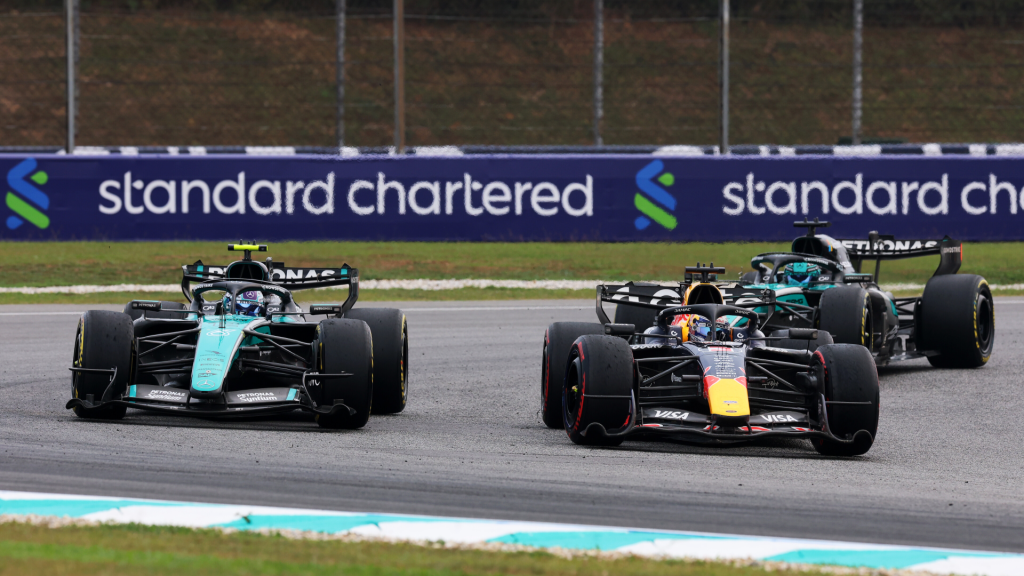
Mercedes considers back-to-back test in Singapore
According to The Race, Mercedes is keeping its options open ahead of Marina Bay, including the possibility of comparing configurations during Friday’s only free-practice session. Antonelli wants the team to establish as quickly as possible whether the new specification genuinely improved the car.
“That’s the question we need to answer because we don’t really know if it made us go faster or worse,” Antonelli said.
The championship leader pointed towards Sepang’s old asphalt as one possible explanation for Mercedes’ difficulties.
“It’s fair to say, this season that whenever we went on really old tarmacs, we’ve struggled,” he explained. “For example, in Zandvoort, McLaren was much quicker than us, especially on the older tarmac. So, I think maybe it’s just a question that the tarmac is just very old and that for the tyres it’s very, very hard, and maybe we just struggle on this kind of tarmac.”
That uncertainty is precisely why Mercedes would benefit from a direct comparison. At Sepang, both cars ran the new specification, leaving engineers without contemporary track data from the previous package under identical conditions.
Russell had already highlighted that limitation during the Malaysian weekend.
“If you could have done a direct back-to-back it would have been great to know, but that’s the challenge of this sport,” he said. “If I put the upgrade package on last week, even if it was worse, we probably still would have been on pole and we’d have been saying it was fantastic. And equally, if we had the old car here, maybe the result would have been even worse.”
New W17 produced downforce — but also more drag
Mercedes’ data has provided some encouragement. Deputy team principal Bradley Lord said the team saw the expected benefits through high and medium-speed corners. The drivers could also feel the additional performance. The problem was elsewhere.
Mercedes struggled particularly in slower corners, while the W17 also lost straight-line speed.
“That’s probably one of the lesser question marks,” Lord said of the straight-line deficit. “We know that adding downforce that brings with it drag, and the calculation is that what you gain in the corners will outweigh what you lose down the straights.”
“We’ve seen what we’re expecting there, we’re seeing the benefit in the high-speed corners and the medium-speed — and the drivers say they can feel it as well. But there’s no doubt that we’ve struggled in certain corners all weekend, particularly the slower ones.”
That fits with Wolff’s initial assessment after qualifying, when the Mercedes boss identified both low-speed understeer and straight-line losses as major concerns.
Reverting the entire package is not straightforward
A return to the previous specification would be considerably more complicated than simply removing a new floor. Mercedes made substantial changes to the W17’s sidepod profile at Sepang, and those revisions required alterations to the car’s internal cooling architecture.
That integration means Mercedes cannot necessarily switch freely between the complete old and new specifications during a race weekend.
The team could nevertheless use different configurations to gather comparative data, while a longer-term rollback remains among the possibilities if Mercedes concludes that elements of the upgrade have not worked as intended. Lord stressed that the investigation remains open.
“There are many things to unpick,” he said. “We’ve seen some teams without upgrades take a step forward this weekend. Other upgraded teams have taken a step forward, while [some other] teams that have upgrades have performed less well than we might have expected.”
“We’re not the only people with some questions to answer as we leave the weekend. But certainly we’ve got to unpick what is down to what and understand if that has any implications on how we head into Singapore and the remaining six races after that.”
Mercedes had already committed significant resources to the package despite shifting much of its development focus towards its 2027 Formula 1 car. The Sepang update was intended to be the W17’s final substantial aerodynamic development of the season.
Singapore sprint format leaves Mercedes little time
The biggest complication is the schedule. Singapore hosts a sprint weekend in 2026, meaning Mercedes has only FP1 on Friday before sprint qualifying begins the competitive portion of the event. Any comparison therefore needs to provide useful information almost immediately.
Mercedes cannot afford to spend an entire weekend experimenting while Antonelli approaches the decisive phase of the Drivers’ Championship. The Italian left Sepang with an 84-point advantage over Russell after finishing second behind Max Verstappen. Russell’s late power-unit failure prevented Mercedes from securing a double podium and dramatically increased the gap between its drivers.
The problem has subsequently created another complication: Russell now faces a Singapore grid penalty after exhausting his engine allocation.
That means Mercedes arrives at Marina Bay trying to solve three separate problems: understanding the aerodynamic package, managing Russell’s power-unit situation and protecting Antonelli’s substantial championship advantage.
For the upgrade itself, however, the central question remains surprisingly simple. Mercedes expected three tenths. It still does not know whether it gained them.
GRANDE PRÊMIO follows all the latest Formula 1 news ahead of the Singapore GP.
F1 today: FAQ
Why did F1 cars lose power before the Bahrain GP in Malaysia?
The FIA identified a combination of low engine speed, low grip, wet-weather energy management settings and Sepang’s sector configuration. It distributed a software update before the race and announced a full review with teams and power unit manufacturers.
Can Kimi Antonelli win the F1 championship in Singapore?
No. Antonelli leads George Russell by 84 points, but even a Singapore Sprint and Grand Prix double would not secure the title. Austin on 25 October is his earliest possible opportunity, depending on his results and those of the remaining contenders.
When is the next F1 race, and is Singapore a Sprint weekend?
The next race is the Singapore Grand Prix on 11 October, with track activity beginning on Friday, 9 October. It is a Sprint weekend: Sprint qualifying takes place on Friday, followed by the Sprint and Grand Prix qualifying on Saturday.
Will Mercedes remove its Sepang upgrade for the Singapore GP?
Mercedes has not decided to abandon the upgrade. The team is considering different ways to compare its specifications in Singapore as it investigates whether the new package or Sepang’s unusual conditions caused its performance problems.