News Summary
- Verstappen beat Antonelli by 2.307 seconds in Malaysia and 24.573 seconds in Singapore, winning both grands prix.
- In comparable phases at Sepang, Verstappen averaged approximately 0.14s per lap faster over laps 35–42 and 0.38s faster over the final four laps.
- Red Bull’s development has transformed the RB22, while Mercedes has confirmed its latest upgrade is faster but more difficult to optimise.
Max Verstappen’s victories at Sepang and Singapore have provided compelling evidence that Red Bull has moved ahead of Mercedes in Formula 1’s immediate competitive order, raising questions about whether the Austrian team has finally solved the limitations of its RB22 while the championship leaders struggle to extract the full potential of their latest upgrade.
The turnaround has been particularly striking because Mercedes dominated much of the 2026 season, winning 11 of the first 16 grands prix. Red Bull, meanwhile, spent several months trying to reduce the performance gap before introducing a sequence of aerodynamic developments that gradually transformed its competitiveness.
Verstappen’s victory at the Bahrain Grand Prix in Malaysia was his first of the season. One week later, he dominated the Singapore Grand Prix from pole position, securing his second consecutive win and reinforcing the impression that Red Bull has become the benchmark.
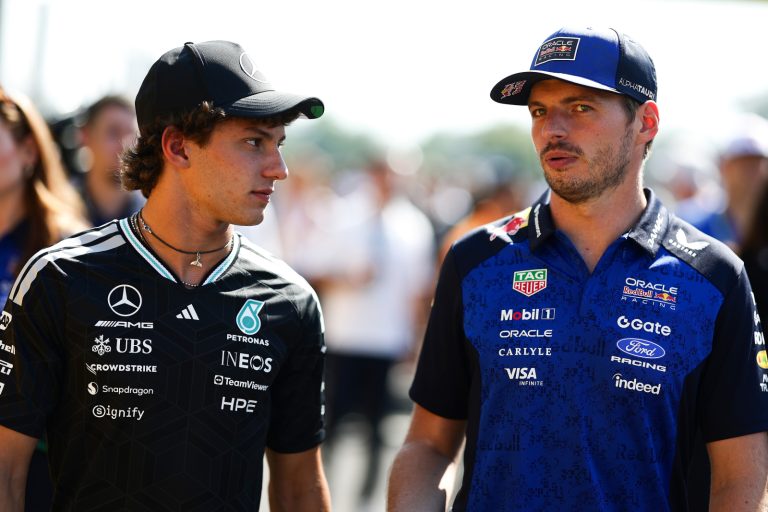
Mercedes team principal Toto Wolff has acknowledged the scale of the improvement, while Kimi Antonelli has admitted that his team needs to find more performance before the United States Grand Prix.
The question is whether the recent results represent a temporary shift caused by circuit characteristics or evidence of a more substantial change in the technical balance between the two teams.
Verstappen vs Antonelli: what the race-pace data shows
The finishing gaps from Malaysia and Singapore provide the starting point for the comparison.
| Statistic | Bahrain GP — Sepang | Singapore GP |
|---|---|---|
| Race distance | 55 laps | 62 laps |
| Max Verstappen | 1st | 1st |
| Kimi Antonelli | 2nd | 3rd |
| Gap to Verstappen | +2.307s | +24.573s |
| George Russell | DNF | 9th |
| Verstappen’s fastest lap | 1:38.220 | — |
At first glance, the difference appears dramatic. Antonelli finished just over two seconds behind Verstappen at Sepang but almost 25 seconds behind him in Singapore.
However, finishing gaps are not equivalent to representative race pace.
The Malaysian race included changing weather, Safety Car periods and different tyre strategies. Singapore also featured neutralisations, traffic and strategic variations, while Russell started near the back because of a power-unit penalty.
A more revealing comparison comes from individual phases of the Malaysian Grand Prix.
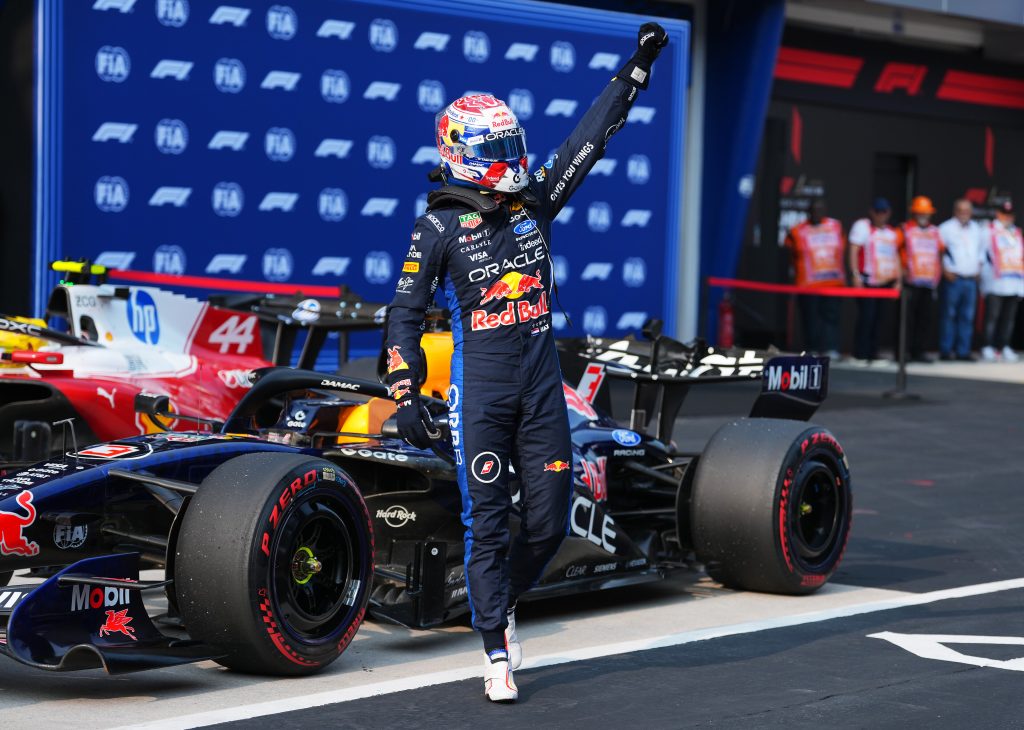
Sepang: Red Bull maintained its advantage on comparable tyres
After the opening stages at Sepang, Verstappen moved into the lead and gradually extended his advantage over Antonelli.
By lap 30, the Red Bull driver was 9.488 seconds ahead. That margin increased to 11.989 seconds after lap 42.
The most useful comparison came after both drivers had switched to soft tyres.
Between laps 35 and 42, Verstappen averaged approximately 0.14 seconds per lap faster than Antonelli.
Although traffic and tyre conditions were not identical, the comparison indicates that Red Bull retained a measurable performance advantage even after the initial strategic differences had been reduced.
The final restart provided another opportunity to assess the two cars.
With four racing laps remaining, Verstappen and Antonelli were separated by less than one second.
| Final stint — Sepang | Verstappen | Antonelli |
|---|---|---|
| Average lap time, laps 52–55 | 1:38.447 | 1:38.822 |
| Average difference | 0.375s/lap faster | — |
| Final gap | Winner | +2.307s |
Verstappen also recorded the fastest lap of the race on lap 55, completing the circuit in 1:38.220.
The comparison is significant because it came after a Safety Car restart, when both drivers were competing for the victory rather than managing a substantial gap.
Red Bull demonstrated a clear advantage during those final four laps, with Verstappen extending his lead despite Antonelli remaining close enough to apply pressure.
That does not establish a universal three- or four-tenths advantage for the RB22, but it confirms that Verstappen had sufficient performance to control the decisive phase of the race.
Singapore exposed a larger Mercedes deficit
The following weekend produced a more emphatic result.
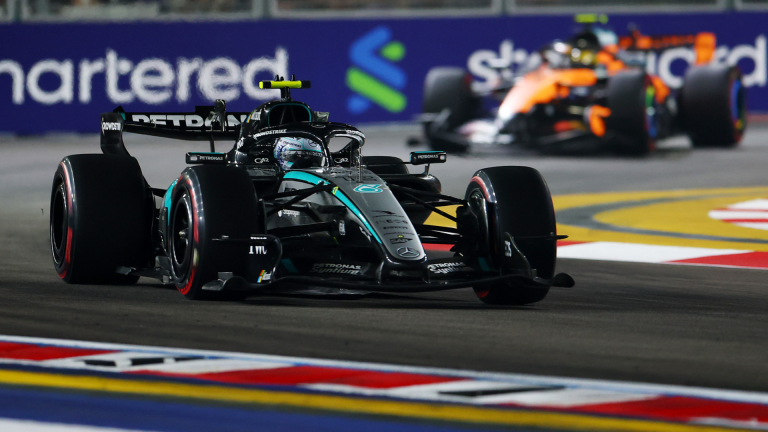
Verstappen took pole position at Marina Bay and controlled the race, finishing 7.335 seconds ahead of Charles Leclerc’s Ferrari and 24.573 seconds ahead of Antonelli.
The Italian completed the podium after recovering positions through strategy and overtaking, while Russell finished ninth following his grid penalty.
The size of the gap between Verstappen and Antonelli was considerably greater than at Sepang, but the race circumstances prevent a simple conversion into an average lap-time deficit.
Dividing the finishing difference by the 62-lap race distance produces approximately 0.396 seconds per lap. That figure describes the accumulated difference spread across the full race, not a controlled comparison of underlying performance.
Nevertheless, the result provides another important piece of evidence.
Verstappen was able to win convincingly at a circuit with very different demands from Sepang, suggesting Red Bull’s improvement is not restricted to a single track configuration.
The Dutchman also won Saturday’s sprint, reinforcing the team’s competitiveness across both shorter and longer race distances.
Mercedes, by contrast, was unable to challenge Red Bull for victory in either event.
Red Bull’s recovery began with its Austrian upgrade
The RB22’s transformation did not begin with the victories in Malaysia and Singapore.
Red Bull introduced an extensive development package at the Austrian Grand Prix in June, targeting several areas of the car.
The changes included revisions to the floor, sidepod inlet, engine cover, rear suspension, rear corner, rear wing and exhaust.
These modifications were designed to improve aerodynamic efficiency, airflow management and the consistency of the car’s performance.
The floor is particularly important under Formula 1’s current regulations because it generates a substantial proportion of the car’s aerodynamic load.
Changes to the sidepods and engine cover can also influence airflow towards the rear of the car, while revisions to the suspension and rear aerodynamic components affect stability and tyre behaviour.
The precise contribution of each component cannot be isolated from public race results, but the broader trend has been significant.
Verstappen secured eight podium finishes in the ten races following the Austrian development package.
Red Bull subsequently introduced further aerodynamic changes, including revisions to the floor and diffuser at Azerbaijan.
Those developments preceded a sequence of increasingly competitive performances, culminating in the victories at Sepang and Singapore.
Mekies credits Verstappen’s technical feedback
Red Bull team principal Laurent Mekies has emphasised Verstappen’s contribution to the development process.
The Frenchman has highlighted the Dutchman’s ability to identify handling limitations and communicate them precisely to engineers.
Mekies described Verstappen’s technical sensitivity as exceptional, arguing that his feedback has been an important part of the team’s recovery.
The Dutchman’s preference for a responsive front end has been a recurring characteristic of his driving style.
A car that responds accurately on corner entry allows Verstappen to commit to aggressive braking and carry speed through the early phases of a corner.
However, achieving that responsiveness without sacrificing rear stability or tyre performance can be difficult.
Red Bull’s recent results suggest the team has improved the balance between those characteristics, although public data does not establish exactly which development produced the greatest gain.
The improvement has also coincided with greater operational consistency under Mekies, who replaced Christian Horner earlier in the season.
Red Bull’s technical programme remains led by Pierre Waché, with Ben Hodgkinson overseeing its power-unit development.
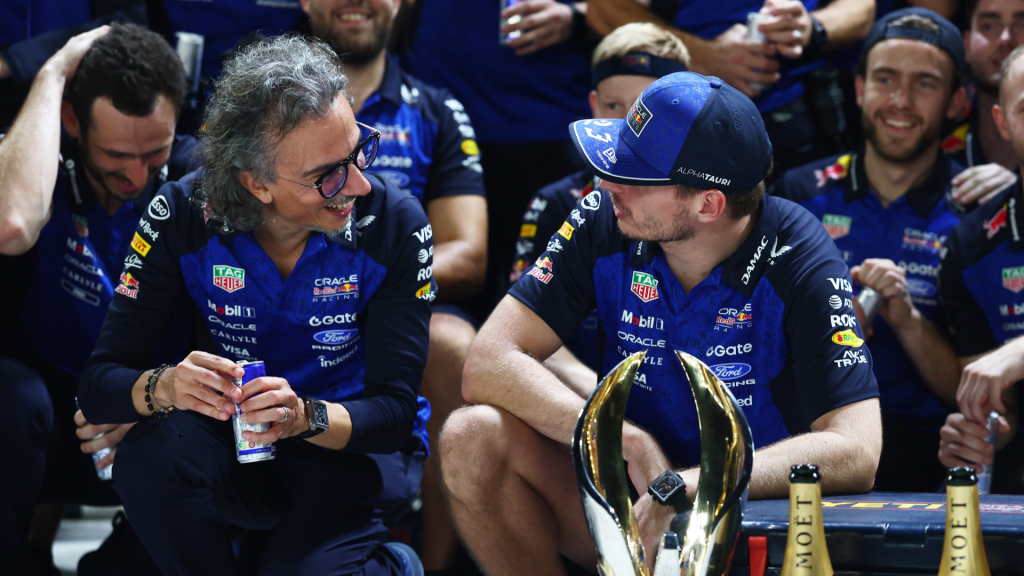
Verstappen’s comments reflect a change in confidence
Verstappen’s public assessments of the RB22 have evolved as the season has progressed.
Earlier in 2026, the Dutchman repeatedly stressed that Red Bull needed to improve its car to compete consistently with Mercedes.
His comments focused on understanding the vehicle’s limitations, improving balance and reducing the gap to the championship leaders.
The tone became more positive as Red Bull’s development programme began producing stronger results.
At Sepang, Verstappen demonstrated confidence in the car across changing weather conditions and different tyre compounds.
His ability to recover from a poor start, overtake both Mercedes drivers and rebuild his advantage after neutralisations provided further evidence of the RB22’s progress.
Singapore reinforced that impression. Verstappen controlled the race from pole position despite communication difficulties with his engineer, maintaining the performance needed to defeat Ferrari and Mercedes.
The shift is significant because the Dutchman’s recent confidence is supported by results across different circuits and race conditions, rather than a single exceptional performance.
Mercedes introduced an upgrade — but struggled to unlock it
While Red Bull progressively improved the RB22, Mercedes encountered difficulties with its latest development package.
The team introduced its first major aerodynamic upgrade since May at Sepang, expecting an improvement of approximately 0.3 seconds per lap.
However, the anticipated gain did not materialise consistently during the Malaysian weekend.
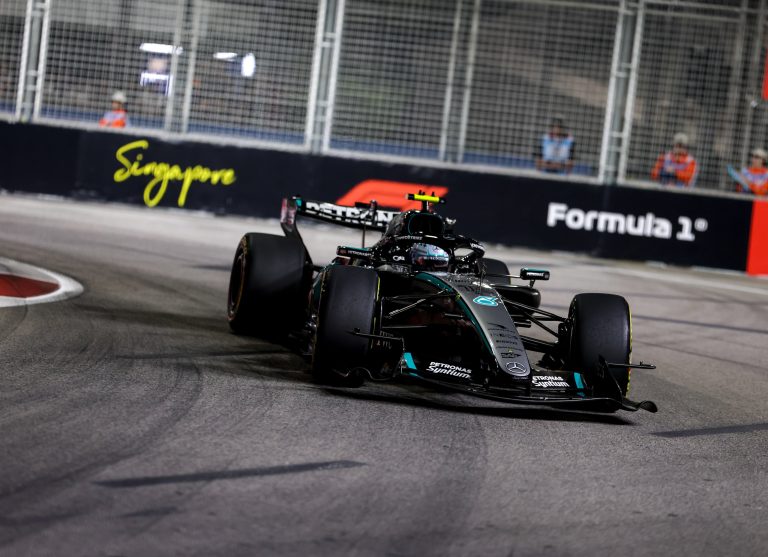
Antonelli qualified fourth, 0.501 seconds behind Verstappen, while Russell was eighth, 0.741 seconds away from pole.
Mercedes identified several possible contributors to its difficulties, including straight-line performance and understeer in slower corners.
The team also struggled to understand why its promising practice pace had not translated into qualifying performance.
Russell’s eventual retirement with a power-unit problem created an additional concern, although the reliability issue was separate from the aerodynamic upgrade investigation.
Mercedes subsequently decided to compare two different car specifications during the Singapore weekend.
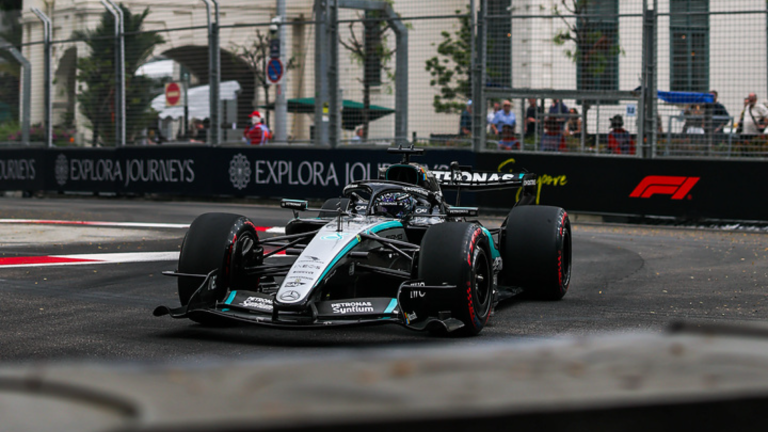
Russell reverted to the older configuration used at Azerbaijan, while Antonelli retained the updated package.
The experiment was designed to establish whether the new components had genuinely improved performance or merely complicated the car’s handling.
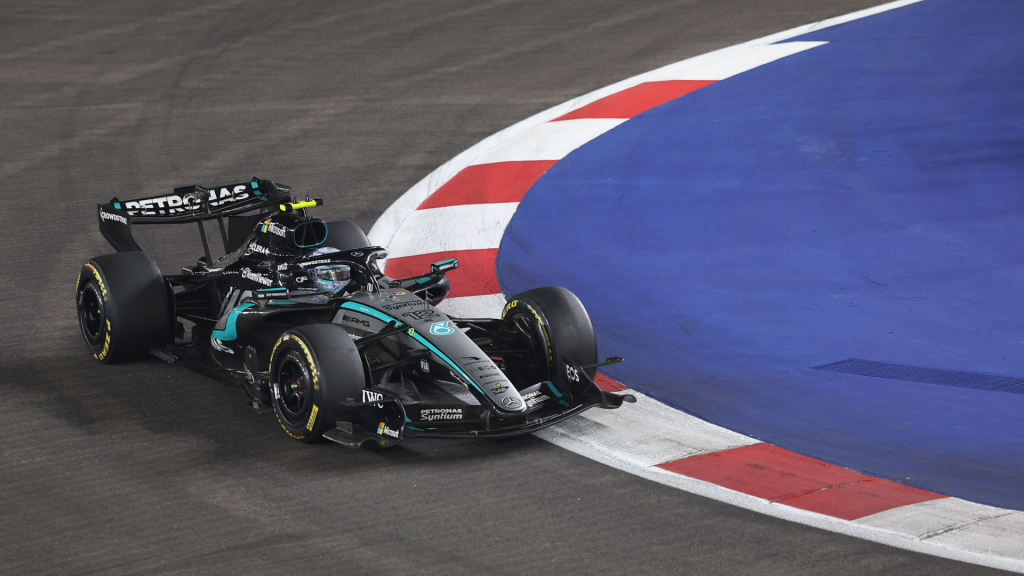
Shovlin confirms Mercedes’ new package is faster
Mercedes’ Singapore comparison produced an important result.
Trackside engineering director Andrew Shovlin confirmed that Antonelli’s updated W17 was faster than Russell’s older specification by the end of the weekend.
“By the end of the weekend, Kimi’s package was clearly the faster of the two,” Shovlin said in Mercedes’ official race report.
The conclusion rules out the simplest interpretation of Mercedes’ recent difficulties: that its latest development had made the car fundamentally slower.
Instead, the evidence points towards a more complicated problem involving the operating window of the updated package.
Wolff acknowledged that the new specification was more difficult to optimise, although it offered additional performance when correctly configured.
Mercedes therefore has a faster version of its own car, but it has not yet demonstrated that the improvement is sufficient to match Verstappen’s Red Bull.
That distinction is central to understanding the competitive situation.
Red Bull appears to have gained more performance relative to its rivals, while Mercedes is still learning how to extract the benefits of its latest development.
The Mercedes technical analysis of its Sepang upgrade examines why the initial performance gain failed to materialise and how the Singapore comparison changed the team’s assessment.
Wolff recognises Red Bull’s development progress
Wolff has acknowledged that Red Bull’s recovery represents a significant technical achievement.
The Mercedes boss praised the Austrian team’s ability to improve its car during the season, particularly after a difficult opening phase.
His assessment reflects the results of the previous two races, where Verstappen demonstrated stronger performance than Mercedes despite the German manufacturer’s development efforts.
Mercedes has nevertheless maintained a substantial championship advantage.
The team won 11 of the first 16 grands prix, while Antonelli remains firmly in control of the Drivers’ Championship.
The Italian extended his advantage over Russell to 102 points after Singapore and could mathematically secure the title at the United States Grand Prix.
The championship scenarios for Antonelli to win the title in Austin illustrate how difficult it would be for his rivals to reverse the standings.
Wolff’s concern therefore relates less to the immediate championship position and more to the direction of technical performance.
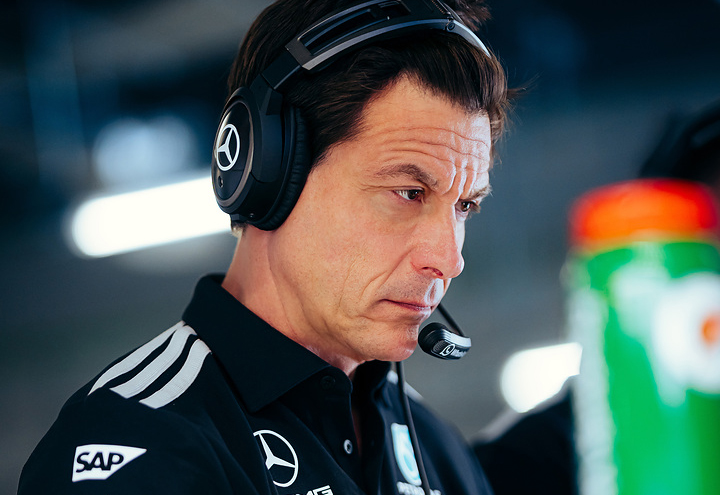
Antonelli sees an opportunity to recover in Austin
Antonelli has also acknowledged that Mercedes needs to improve its understanding of the W17.
The Italian believes the Singapore experiment provided valuable information about the updated package and its setup requirements.
The team made progress throughout the weekend, particularly in qualifying and race conditions, as it moved closer to the correct operating window.
Antonelli’s third-place finish demonstrated that the updated Mercedes remained competitive, even though it could not challenge Verstappen for victory.
The United States Grand Prix will provide another opportunity to evaluate the car at a circuit with a different combination of high-speed corners, slow sections, elevation changes and bumps.
Mercedes will also have a conventional race weekend rather than a sprint format, allowing more practice time to optimise its setup.
Has Red Bull overtaken Mercedes in Formula 1?
The evidence from Malaysia and Singapore supports the assessment that Red Bull currently has the stronger race-winning package in Verstappen’s hands.
At Sepang, the Dutchman demonstrated a measurable advantage during several representative phases, including the final four laps when he averaged approximately 0.375 seconds per lap faster than Antonelli.
At Singapore, he converted pole position into a commanding victory, finishing almost 25 seconds ahead of the Mercedes driver.
Red Bull’s development trajectory also supports the interpretation that the RB22 has improved substantially since the Austrian Grand Prix.
However, the available evidence does not prove that Mercedes has gone backwards in absolute performance.
Shovlin’s assessment confirms that the latest W17 specification is faster than the previous version, while the team’s difficulties appear connected to extracting that performance consistently.
The more defensible conclusion is that Red Bull has improved faster than Mercedes over the recent development cycle, producing a competitive shift that has become visible in the last two grands prix.
Why the final races matter for 2027
The significance of the turnaround extends beyond the current championship.
Red Bull and Mercedes are competing under the same technical regulations that will continue into 2027, making the lessons learned during the final rounds relevant to next season’s development.
Red Bull appears to have established a stronger understanding of its aerodynamic package and its interaction with the power unit.
Mercedes, meanwhile, is still refining the operating characteristics of its latest update.
The German team has already confirmed that its new package offers more performance, but it must improve consistency and setup efficiency to challenge Verstappen more effectively.
Austin will provide the next opportunity to compare the two teams.
The United States Grand Prix takes place from October 23 to 25, with Verstappen attempting to secure a third consecutive victory.
The complete Austin schedule, session times and viewing information are available on GRANDE PRÊMIO.