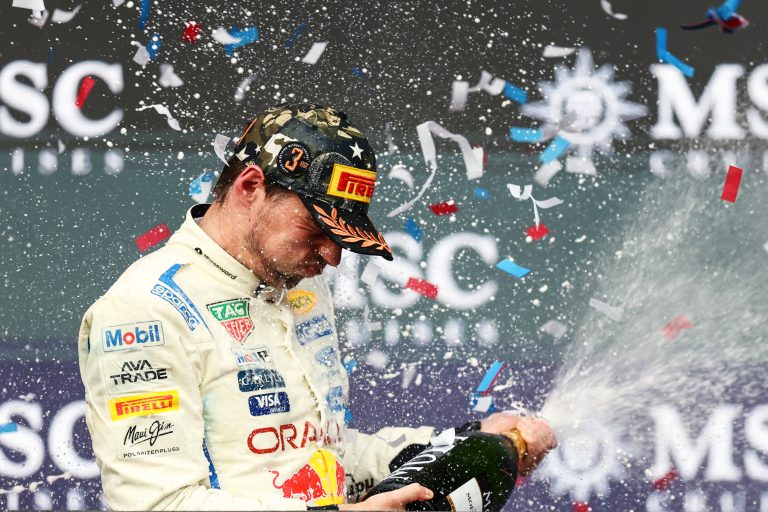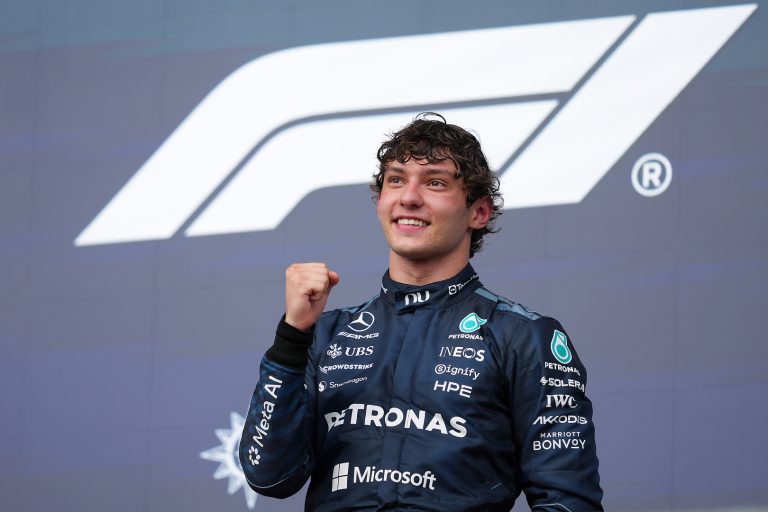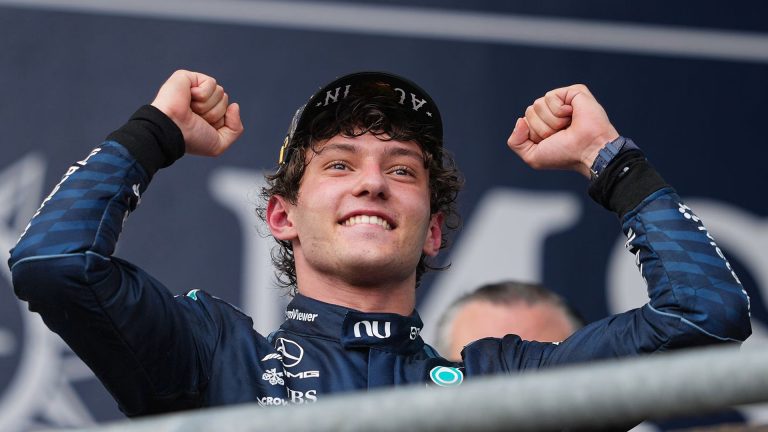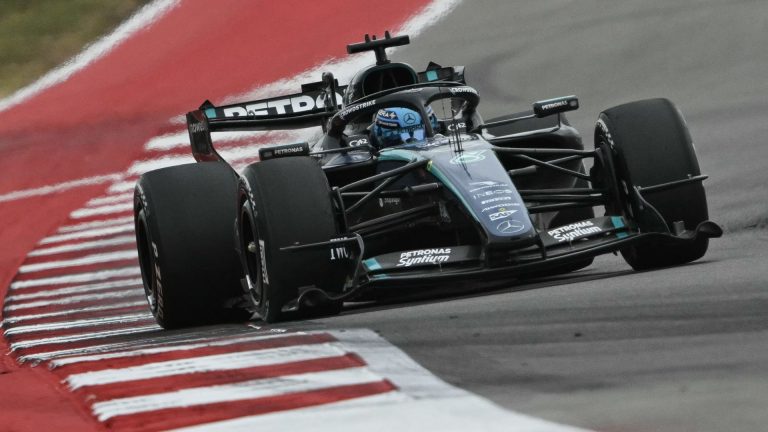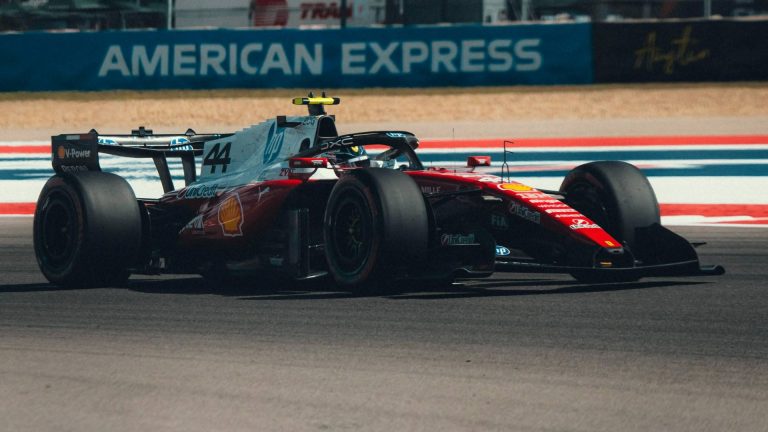

Max Verstappen’s third place at the 2026 Italian Grand Prix was a respectable recovery, but it also exposed why Red Bull could not genuinely challenge Mercedes for victory at Monza.
Verstappen briefly moved ahead of the Mercedes drivers during the race, but once the Silver Arrows applied their superior energy deployment, the Red Bull driver struggled to defend. Combined with a recurring rear-end problem that had compromised his weekend from qualifying onward, the RB22 simply did not have the tools required to sustain a fight for victory.
Red Bull arrived with the wrong balance
The problems began well before the race. Verstappen struggled to find a workable balance on Friday and finished ninth in FP2, 0.818s behind George Russell.
Red Bull quickly identified a recurring balance problem, similar to the issue Verstappen had experienced at Zandvoort. Technical director Pierre Waché acknowledged that the team understood the problem better but still had important setup and component decisions to make.
The RB22’s balance problems at Monza were particularly damaging because Monza leaves little room for a car that is inconsistent through the low-speed corners and over the kerbs.
Verstappen’s situation became even more difficult in qualifying. A recurring rear-end issue cost him at least 0.2s, particularly over bumps and kerbs, leaving him sixth on the grid.
The rear problem never went away
Red Bull investigated whether it could make changes to Verstappen’s car before the race, but parc fermé restrictions complicated the situation.
The team ultimately decided against a major repair because it could not establish that the component was sufficiently damaged to justify a change without potentially forcing Verstappen to start from the pit lane. As a result, he had to race with essentially the same problem.
Verstappen later explained that the rear issue remained noticeable during the race. The RB22 rear-end problem affected the car over kerbs, bumps and in slower corners, limiting how aggressively he could attack.
That mattered because Verstappen’s strongest weapon at Monza was not enough on its own.
Verstappen could fight under braking — but not on the straights
The Red Bull remained strong under braking, allowing Verstappen to attack rivals when he reached the heavy braking zones.
That was enough to put him into contention and eventually allow him to move ahead of the Mercedes drivers. But once the battle moved onto the straights, the balance changed.
Verstappen said that Mercedes was simply too fast, particularly because of its advantage in energy deployment. Around a circuit dominated by long acceleration zones, that deficit became extremely difficult to overcome.
The difference between Red Bull and Mercedes at Monza was therefore not just a question of peak engine power. It was about how effectively the two cars could deploy electrical energy throughout the lap.
Monza magnified Mercedes’ advantage
Monza is uniquely punishing when a car cannot match its rivals on the straights.
There are long acceleration zones between the Retifilo, Roggia, Lesmo, Ascari and Parabolica sections, while the low-downforce configuration reduces the amount of aerodynamic drag teams can afford to carry.
That creates a simple problem: if a driver loses time in acceleration, he cannot necessarily recover it in the corners.
Verstappen could use the RB22’s braking strength to attack, but once Mercedes got back onto the throttle, the Red Bull was vulnerable. As he put it after the race, defending became extremely difficult once he was in front.
The result was a race in which Verstappen could challenge Mercedes, but could not control the race against it.
Mercedes also had the better overall package
The Silver Arrows were not merely faster in a straight line. Mercedes arrived at Monza with a package that worked particularly well with the circuit’s demands.
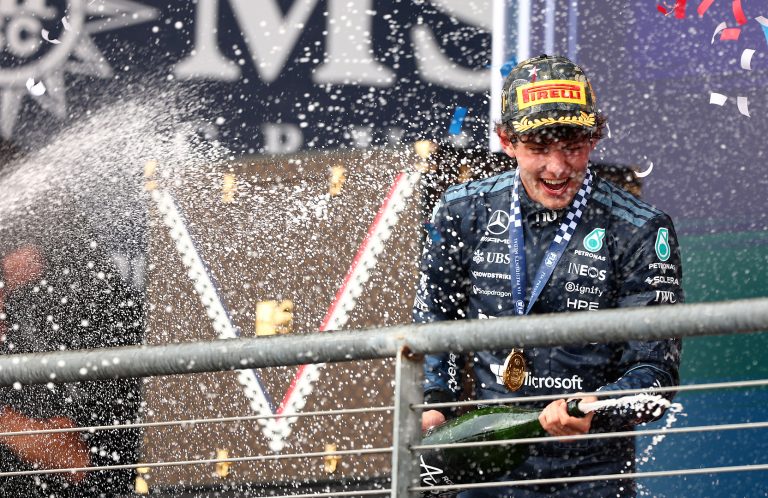
George Russell qualified on the front row and spent much of the race fighting for victory. Kimi Antonelli, meanwhile, recovered from 19th on the grid to win the race, passing Verstappen on his way through the field.
Antonelli’s recovery became one of the defining stories of the weekend, but the Mercedes fight for victory at Monza also demonstrated how much performance the W17 had available once Antonelli reached the front.
For Verstappen, that was the frustrating part. Red Bull was close enough to fight for the podium, but not close enough to dictate the race.
Verstappen’s third place was still important
That does not make the result a failure.
After a difficult weekend and a compromised car, Verstappen still finished third, securing his fifth podium of the 2026 season. He also recovered from sixth on the grid and briefly put himself in a position to challenge for the win.
The result was therefore a useful salvage operation rather than evidence that Red Bull had suddenly solved its problems.
More importantly, Verstappen avoided another damaging weekend in a championship in which his title hopes were already under pressure. Antonelli’s victory extended the Mercedes driver’s championship advantage, while Verstappen remains sixth in the standings.
The bigger problem is what comes next
The key question for Red Bull is whether Monza was a circuit-specific setback or evidence of a deeper weakness in the RB22.
Verstappen’s admission that Red Bull had a “big gap” to its rivals came before the weekend had even reached its decisive stages. The race confirmed that the team’s problems were not simply the result of one bad qualifying session.
Madrid should provide a useful comparison.
The new Madring circuit has a very different combination of corners, elevation changes and semi-urban sections, meaning Red Bull will have to prove that the Monza weakness was primarily related to the characteristics of the Italian track.
That makes the Spanish GP important for more than Verstappen’s championship ambitions. It could reveal whether Red Bull has a fundamental performance deficit against Mercedes or simply failed to optimise the RB22 for one of the most unusual circuits on the calendar.
Why Verstappen couldn’t beat Mercedes
Ultimately, Verstappen could not challenge Mercedes consistently at Monza because three problems came together.
First, the RB22 never found the balance Red Bull wanted. Second, the rear-end issue compromised Verstappen’s confidence and performance over kerbs and bumps. Third, Mercedes had the superior energy deployment on the long straights, making it extremely difficult for Verstappen to defend once a Silver Arrow got alongside.
The combination was enough to turn a potential victory contender into a podium finisher.
Verstappen’s ability to finish third despite those limitations was encouraging. But if Red Bull wants to turn its four-time world champion’s remaining 2026 title hopes into a realistic challenge, Madrid needs to show that Monza was an exception rather than the new normal.
FAQ
Why was Max Verstappen unable to challenge Mercedes at Monza?
Red Bull struggled with the RB22’s rear-end balance throughout the weekend, while Mercedes had a significant advantage in energy deployment on Monza’s long straights. Verstappen could fight back under braking but struggled to defend once the Mercedes cars accelerated away.
What was wrong with Max Verstappen’s Red Bull at the 2026 Italian GP?
Verstappen’s RB22 had a recurring rear-end problem that affected the car over bumps, kerbs and in low-speed corners. Red Bull investigated the issue but could not make a major change before the race without risking a pit-lane start.
Can Max Verstappen still fight for the 2026 F1 title?
Verstappen remains mathematically in contention, but his sixth-place position and large points deficit make a late comeback extremely difficult. Red Bull will need a significant improvement in competitiveness, starting with the new Madrid circuit, if Verstappen is to become a serious title threat.